
Sleep Efficiency: What’s a Good Score, and How to Improve It
Sleep efficiency is one of the most useful numbers your smartwatch or ring quietly reports each morning — and one of the least understood. It is simply the share of your time in bed that you actually spend asleep, written as a percentage. You can be in bed for eight hours and still have poor sleep efficiency if a good chunk of that time was spent lying awake. Here is what it means, what counts as a healthy figure, and how to nudge yours in the right direction.
What sleep efficiency actually measures
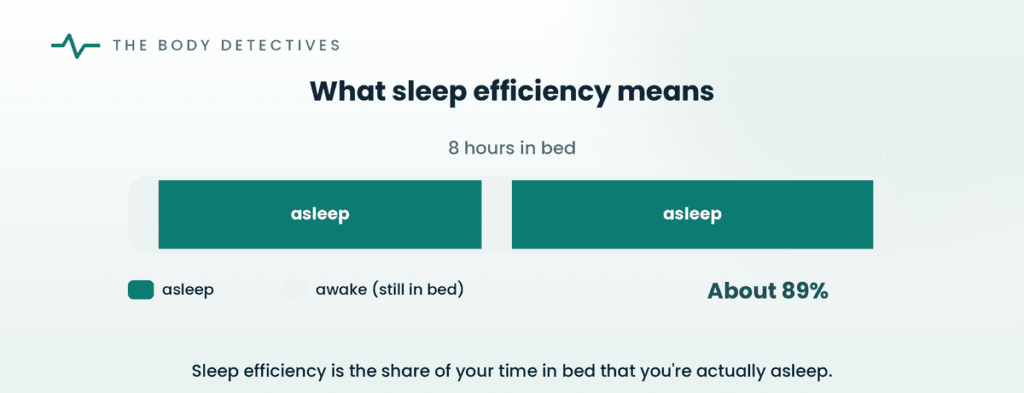
Sleep efficiency compares two things: the total time you were in bed, and the time you were genuinely asleep within it. Divide the second by the first, multiply by a hundred, and you have your percentage. The gap between the two is made up of the minutes spent falling asleep, brief awakenings through the night, and any time lying awake before you get up. The diagram below shows how it fits together.
What counts as a good sleep efficiency?
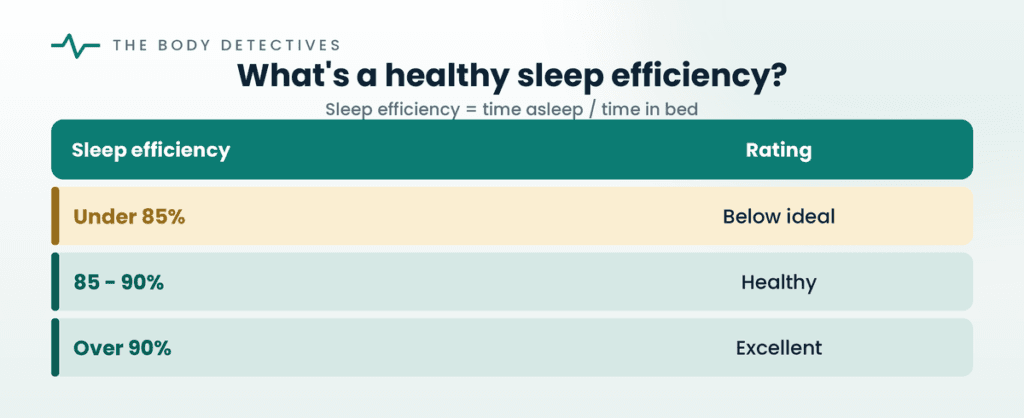
As a rule of thumb, spending at least 85% of your time in bed asleep is considered healthy, with 90% and above seen as excellent. Slip below 85% regularly and it suggests your sleep is more broken than restful. The chart below sums it up.
One important caveat: the figure from a wearable is an estimate, not a clinical measurement. A single off night means very little. What matters is the trend over a couple of weeks, not one disappointing morning — and chasing a flawless score can itself become a source of stress.
Why low sleep efficiency happens
Low sleep efficiency usually comes down to one of two things: taking a long time to fall asleep, or waking repeatedly through the night. Common culprits include an irregular schedule, caffeine or alcohol too late in the day, a bright or noisy bedroom, screens before bed, stress, and — very commonly — simply spending too long in bed. Lying awake for an hour hoping for sleep drags your efficiency down, even though it feels like you are “trying” to sleep.
How to improve your sleep efficiency
The most powerful fix is often counter-intuitive: spend a little less time in bed, not more, so that the time you are there is mostly spent asleep. Beyond that, keep a consistent wake-up time, get up if you cannot sleep rather than lying there frustrated, keep the room dark, cool and quiet, and cut caffeine and alcohol in the hours before bed. Because deep, unbroken sleep is also when your heart rate variability recovers, a better efficiency often shows up across your other morning metrics too.
When to see a doctor
If your sleep efficiency stays low despite good habits — or if you regularly struggle to fall asleep, wake unrefreshed, snore heavily, or feel sleepy during the day — it is worth speaking to a doctor. Persistent insomnia and conditions such as sleep apnoea are common, treatable, and worth catching early. A wearable’s estimate is a prompt to ask the question, not a diagnosis on its own.
The bottom line
Sleep efficiency turns a vague feeling — “I slept badly” — into a number you can actually work with. Aim for 85% or more, watch the trend rather than any single night, and remember that the simplest lever is matching your time in bed to the sleep you genuinely need. To see where that sleep time is really going, it also helps to understand your sleep stages.
This article is for general educational purposes only and is not a substitute for professional medical advice, diagnosis or treatment. Always speak to your own doctor about your health and before making changes. See our Medical Disclaimer for more information.