VO2 Max by Age: What’s a Good Score and How to Improve It
If your smartwatch shows a VO2 max number, comparing your VO2 max by age is the quickest way to tell whether it’s good, average, or worth working on. VO2 max is the maximum amount of oxygen your body can use during all-out exercise, and it’s widely considered the single best measure of cardiorespiratory fitness — as well as one of the strongest predictors of long-term health. This guide explains what counts as a good score for your age and sex, how it changes over the years, and how to improve it.
What is VO2 max?
VO2 max (maximal oxygen uptake) measures how much oxygen your heart, lungs, blood, and muscles can deliver and use during intense exercise. It’s reported in millilitres of oxygen per kilogram of body weight per minute (ml/kg/min) — the higher the number, the bigger your aerobic “engine.” Because it reflects your whole oxygen-delivery system working together, VO2 max is a remarkably good gauge of overall fitness, and large studies have linked higher levels to a much lower risk of early death.
What’s a good VO2 max by age?
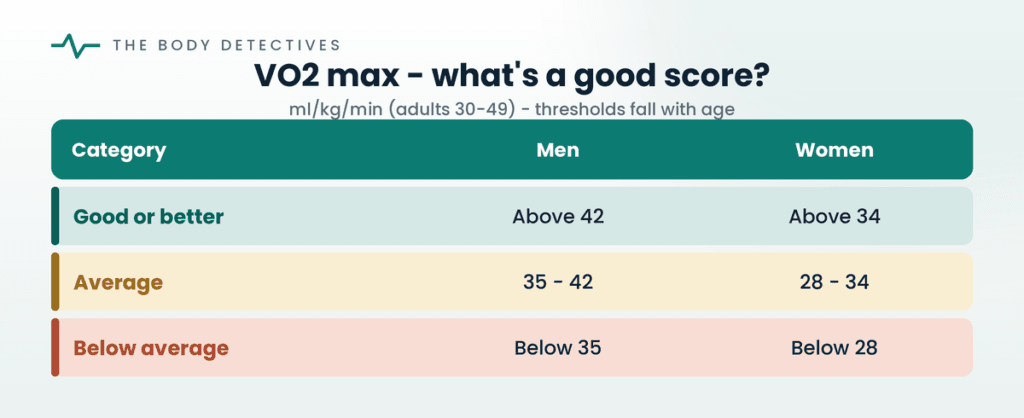
There’s no single “normal” VO2 max — what counts as good depends heavily on your age and sex, and men generally score higher than women because of differences in body composition and blood. The table below is a general guide for adults in their thirties and forties; the thresholds shift lower with each decade.
| Category | Men (ml/kg/min) | Women |
|---|---|---|
| Good or better | Above 42 | Above 34 |
| Average | 35–42 | 28–34 |
| Below average | Below 35 | Below 28 |
Elite endurance athletes sit far above these ranges — often 60 ml/kg/min and up. For everyday health, simply climbing out of the “below average” band brings a meaningful drop in risk.
How VO2 max changes with age
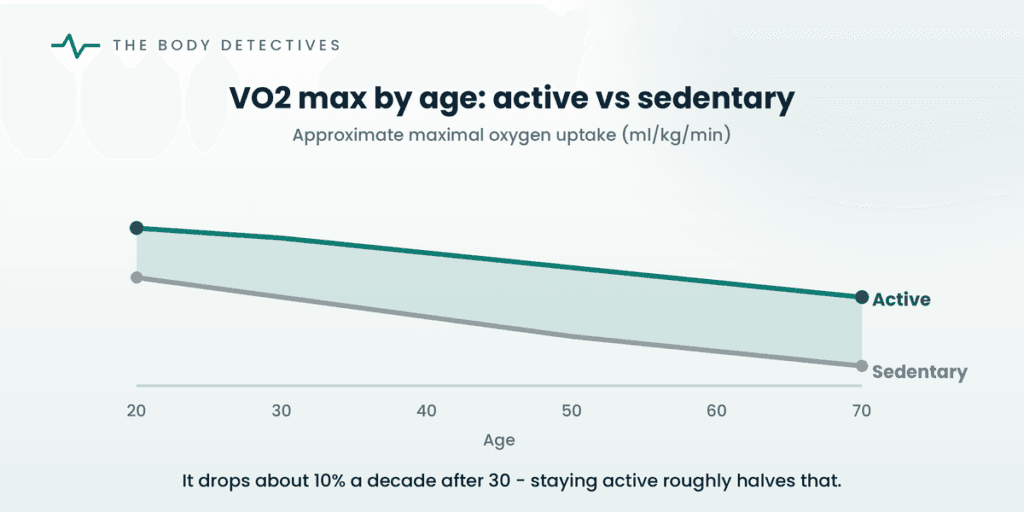
VO2 max peaks in your twenties and then declines — by roughly 10% per decade after age 30 in people who don’t train. The encouraging part is how much control you have: staying active cuts that decline to around 5% per decade and keeps your whole curve much higher, so a fit 60-year-old can easily out-score a sedentary 30-year-old.
Why VO2 max matters
VO2 max isn’t just for athletes. Research following large groups of people has found that higher cardiorespiratory fitness is one of the strongest predictors of living longer — in some studies, a low level carried more risk than smoking or diabetes. The American Heart Association has even suggested treating fitness as a “vital sign.” Because VO2 max is so closely tied to heart and lung health, improving it tends to lift almost everything else.
How to improve your VO2 max
The good news: VO2 max responds to training at any age, often improving 5–15% within a couple of months. The most effective approach combines:
- Regular aerobic exercise — brisk walking, jogging, cycling, or swimming most days
- High-intensity intervals — short, hard bursts (for example, four rounds of four minutes near your max, with easy recovery between) are especially powerful
- Consistency over time — steady training beats the occasional hard session
- Building more general movement into your day
For general activity targets, the NHS recommends at least 150 minutes of moderate or 75 minutes of vigorous activity a week, plus muscle-strengthening twice a week. If you’re older, very unfit, or have a heart condition, check with your doctor before starting vigorous exercise.
How accurate is your watch’s VO2 max?
Smartwatches and fitness trackers estimate VO2 max from your heart rate and pace during exercise rather than measuring it directly. For most people the estimate lands within about 5–10% of a lab test, but it’s less reliable for beginners, very fast runners, or when you’re ill or overtrained. Treat the figure as a trend to watch over weeks and months, not an exact value — a true measurement needs a lab test with breath-by-breath gas analysis.
When to see a doctor
A very low VO2 max, or a sudden unexplained drop, is worth discussing with your doctor — especially if you also feel breathless or tired during everyday activities. And before taking up hard, high-intensity training (particularly if you’re over 40, haven’t exercised in a while, or have heart, lung, or blood-pressure concerns) it’s sensible to get the all-clear first. Your resting heart rate and heart rate variability can add useful context alongside VO2 max.
The bottom line
VO2 max is one of the most meaningful numbers your wearable gives you — a window into how well your heart and lungs work and a strong signal for long-term health. Compare yours against your own age and sex rather than a universal “normal,” remember the figure is an estimate, and know that consistent aerobic training can move it in the right direction at any age.
This article is for general educational purposes only and is not a substitute for professional medical advice. Always consult your own doctor before starting a new exercise programme or making changes to your health routine. See our Medical Disclaimer for more information.