Testosterone Levels by Age: What’s Normal and What’s Low
Understanding your testosterone levels by age helps you tell the difference between a normal part of getting older and a real problem worth checking. Testosterone is the main male sex hormone — it drives sex drive, muscle and bone strength, energy, and mood — and it naturally peaks in early adulthood before drifting down over the decades. This guide shows you what’s normal, what counts as low, how the number changes with age, and when it’s worth seeing a doctor.
What is testosterone?
Testosterone is a hormone made mainly in the testicles in men, and in much smaller amounts in the ovaries and adrenal glands in women. In men it controls the development of male features at puberty and, throughout life, helps maintain muscle mass, bone density, red blood cell production, sex drive, and a general sense of drive and wellbeing. Women need a small amount too, but their levels are far lower. For a clear overview of what testosterone does, the Society for Endocrinology is a reliable source.
Normal testosterone levels by age
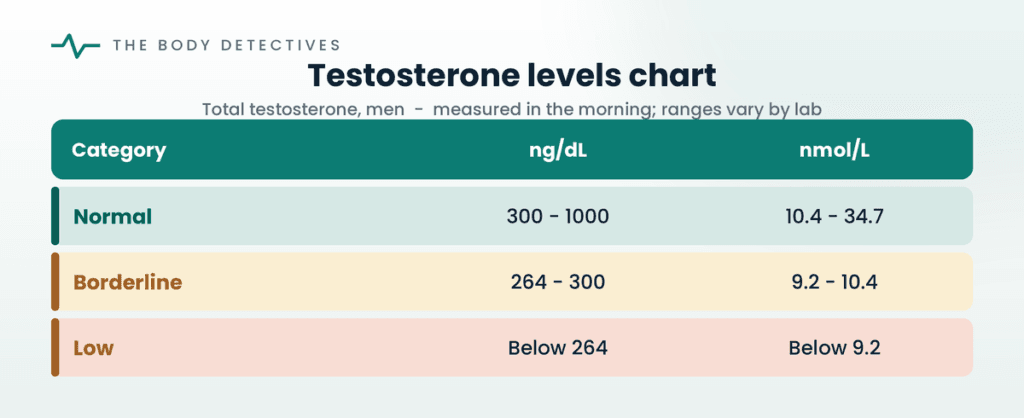
Testosterone is checked with a blood test, ideally taken in the morning (before about 10 a.m.) when levels are highest, and usually repeated on a second morning if the first comes back low. It’s reported in nanograms per deciliter (ng/dL) in the US and nanomoles per liter (nmol/L) in most other countries. The table below is a general guide for total testosterone in adult men.
| Category | Total testosterone (ng/dL) | nmol/L |
|---|---|---|
| Normal | 300–1000 | 10.4–34.7 |
| Borderline (low-normal) | 264–300 | 9.2–10.4 |
| Low | Below 264 | Below 9.2 |
The modern “harmonized” reference range for healthy adult men is about 264–916 ng/dL (9–32 nmol/L), but ranges differ between laboratories. Just as important, a number on its own doesn’t diagnose anything: doctors weigh your symptoms alongside your level, which is why two men with the same reading can be managed very differently.
How testosterone changes with age
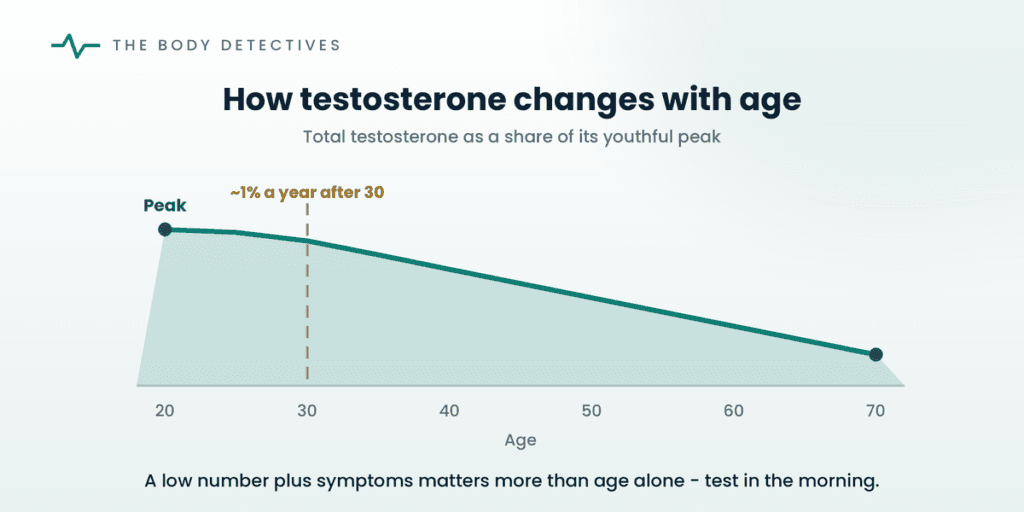
Testosterone climbs through puberty, peaks in the late teens and twenties, and then declines slowly — by roughly 1% a year from around age 30. That means a man in his sixties may have noticeably less testosterone than he did at 25, and this gradual fall is a normal part of aging rather than a disease in itself. What matters is whether the decline is actually causing symptoms.
Signs and symptoms of low testosterone
When testosterone is genuinely low (a state doctors call hypogonadism), it can cause:
- Reduced sex drive and fewer or weaker erections
- Persistent fatigue and low energy
- Low mood, irritability, or poor concentration
- Loss of muscle and strength, and more body fat
- Reduced body or facial hair
- Over time, weaker bones
These symptoms overlap heavily with stress, poor sleep, and other conditions — which is exactly why a blood test matters before assuming testosterone is the cause.
What causes low testosterone?
- Normal aging
- Carrying excess weight, especially around the middle (fat tissue converts testosterone into estrogen)
- Type 2 diabetes and metabolic syndrome — see our guide to blood sugar levels
- Poor sleep or untreated sleep apnea
- Long-term stress, which keeps cortisol high
- Heavy alcohol use
- Certain medicines, such as opioids and long-term steroids
- Problems with the testicles or the pituitary gland, and some genetic conditions
Because several of these are treatable, finding the cause is far more useful than chasing the number.
How to support healthy testosterone naturally
For many men — especially those who are overweight or sedentary — lifestyle changes can meaningfully improve testosterone:
- Lose excess weight if you’re carrying it
- Do regular strength training and stay generally active
- Get enough good-quality sleep
- Manage stress and conditions like diabetes
- Keep alcohol moderate
Be cautious with over-the-counter “testosterone-boosting” supplements — most have little solid evidence behind them, and many aren’t well regulated. Treating the underlying issue, such as weight, sleep, or a chronic illness, tends to work far better.
A note on testosterone replacement therapy (TRT)
If a doctor confirms genuinely low testosterone alongside symptoms, they may discuss testosterone replacement therapy. TRT can help the right people, but it’s a medical treatment with real benefits and risks — including effects on fertility — and it needs proper assessment and ongoing monitoring. It isn’t a shortcut for healthy men chasing higher numbers.
When to see a doctor
See your doctor if you have ongoing symptoms like low libido, erectile problems, unusual fatigue, or low mood — particularly alongside weight gain or poor sleep. Get checked sooner if you’ve had an injury or condition affecting the testicles, or if you take medicines (such as opioids or steroids) that can lower testosterone. Your doctor can arrange a morning blood test and, if needed, check free testosterone and other hormones to see the full picture.
The bottom line
Testosterone naturally falls with age, and a lower number on its own is rarely a reason to worry. What counts is the combination of a genuinely low level and real symptoms, confirmed on a morning blood test. For most men, looking after weight, sleep, activity, and any underlying conditions is the most powerful way to keep testosterone healthy — with medical treatment kept for those who truly need it.
This article is for general educational purposes only and is not a substitute for professional medical advice. Always consult your own doctor before making changes to your health routine or starting any treatment. See our Medical Disclaimer for more information.