Heart Rate Variability (HRV): What It Is and What’s a Good Score
Heart rate variability (HRV) is one of the most interesting numbers on your smartwatch — and one of the most misunderstood. Unlike most health metrics, with HRV a higher number is usually better, not worse. So what exactly is heart rate variability, what counts as a good score, and how can you improve yours? Let’s decode it.
What is heart rate variability (HRV)?
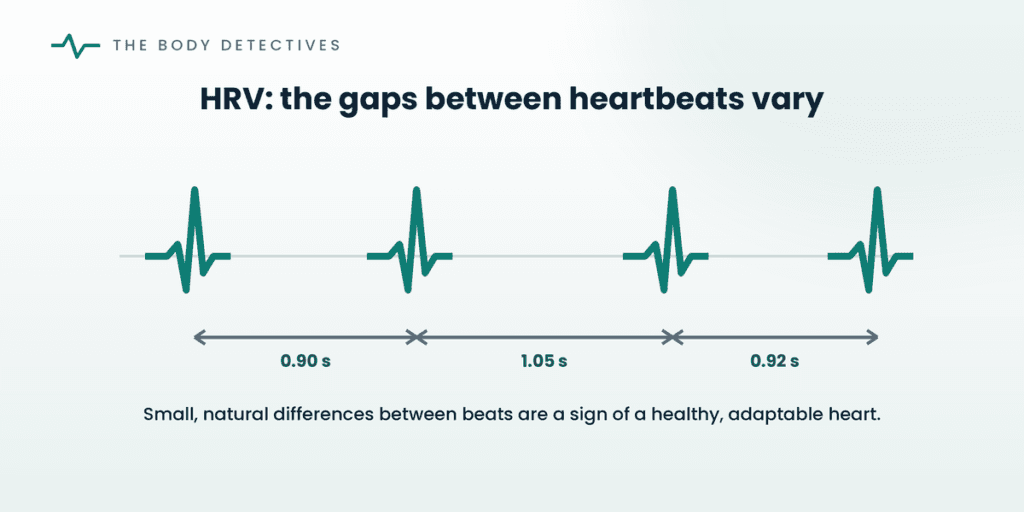
Heart rate variability is the tiny variation in time between each of your heartbeats. Even if your heart rate is a steady 60 beats per minute, the gaps between beats aren’t perfectly even — one might be 0.9 seconds, the next 1.05 seconds. HRV measures those differences, usually in milliseconds. It’s not the same as your heart rate: heart rate is how often your heart beats, while HRV is how much the timing varies.
Why higher HRV is usually better
Those variations are controlled by your autonomic nervous system — the automatic system that balances “fight or flight” with “rest and digest.” A higher HRV generally means your body is relaxed, well-recovered, and able to adapt quickly to demands, which is why athletes often have high values. A lower HRV can be a sign of stress, fatigue, poor recovery, or illness. In short, HRV is a useful window into how well your body is coping and recovering.
What’s a “good” HRV score?
Here’s the most important thing to understand: there is no single “good” HRV number. It varies enormously from person to person depending on age, fitness, genetics, and even the device you use — it also naturally declines as we get older. Comparing your HRV to a friend’s is meaningless. What actually matters is your own trend over time: is your baseline stable, rising, or dropping? That’s the signal worth watching.
What raises and lowers your HRV
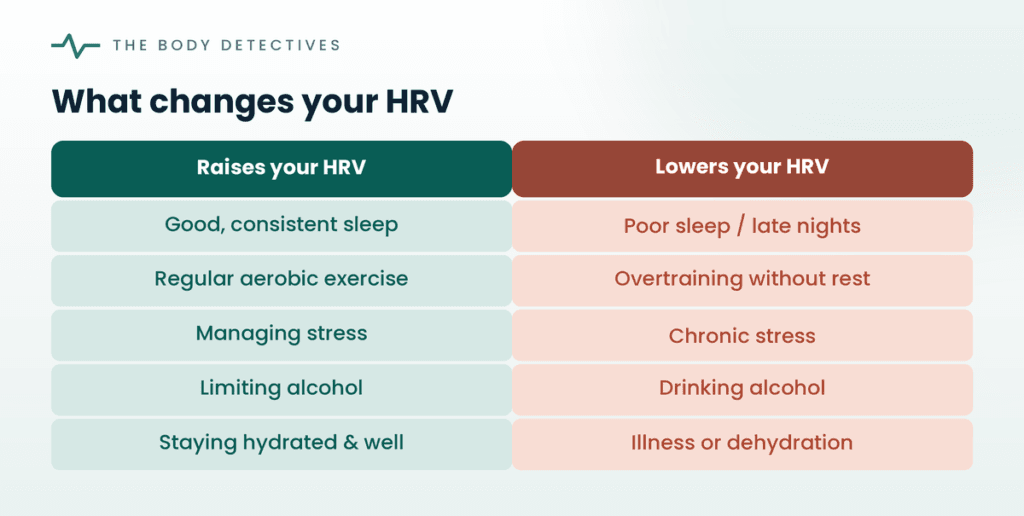
Day to day, your HRV responds to how you treat your body. Good sleep, regular aerobic exercise, managing stress, limiting alcohol, and staying well-hydrated all tend to push it up. Poor sleep, chronic stress, overtraining without rest, alcohol, and illness tend to pull it down — which is exactly why a sudden drop can be an early hint that you’re run down or coming down with something.
How wearables measure HRV
Smartwatches and rings (such as Apple Watch, Garmin, Oura, and Whoop) usually measure HRV automatically, often overnight, and feed it into “recovery” or “readiness” scores. These are genuinely useful for spotting trends, but remember they’re wellness tools, not medical devices — focus on the pattern over days and weeks rather than obsessing over a single morning’s number. For a reliable overview, see the Cleveland Clinic.
When should you see a doctor?
HRV from a wearable isn’t a diagnostic test, so try not to over-interpret it. That said, see your doctor if you notice a large, sustained drop alongside symptoms like unusual fatigue, breathlessness, or palpitations, or if you have any concerns about your heart rhythm. To understand the bigger picture of your heart, it helps to read our guides to resting heart rate by age and how stress affects your body in our guide to cortisol levels.
The bottom line
Heart rate variability is the small variation between your heartbeats, and a higher value usually reflects better recovery and resilience. There’s no universal “good” score, so track your own trend rather than chasing someone else’s number — and use the everyday habits that nudge it in the right direction. Treat it as a helpful guide to recovery, not a medical diagnosis.
This article is for general educational purposes only and is not a substitute for professional medical advice. Always consult your own doctor about your personal health. See our Medical Disclaimer for more information.