Sleep Stages: Light, Deep, REM, and How Much You Need
If your sleep tracker breaks your night into sleep stages — light, deep, and REM — it’s showing you something your body has been doing all along: cycling through distinct phases that each do a different job. Far from being a single “off” switch, sleep is an active, structured process, and understanding these stages explains why both how long and how well you sleep matter. This guide walks through each stage, how a normal night unfolds, and how much sleep you actually need.
The stages of sleep
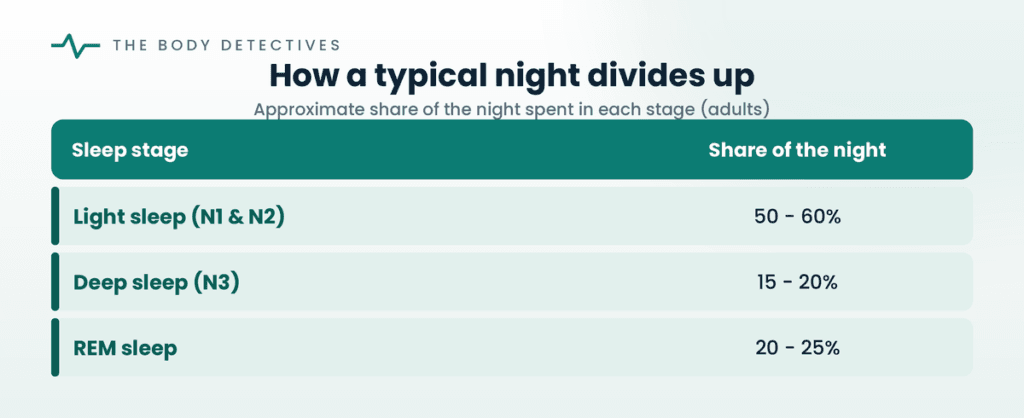
Sleep is divided into non-REM (NREM) and REM sleep. NREM has three stages — N1, N2, and N3 — that get progressively deeper, followed by REM, when most dreaming happens. Your brain moves through them in roughly 90-minute cycles, completing four to six cycles a night.
| Sleep stage | Share of the night |
|---|---|
| Light sleep (N1 & N2) | 50–60% |
| Deep sleep (N3) | 15–20% |
| REM sleep | 20–25% |
- Light sleep (N1 & N2) is the largest share of your night. N1 is the brief drifting-off phase; N2 is stable light sleep where your heart rate and temperature fall and your brain files away memories.
- Deep sleep (N3), or slow-wave sleep, is the most physically restorative stage — your body repairs tissue, builds bone and muscle, releases growth hormone, and strengthens immunity. It’s hardest to wake from, and you get most of it early in the night.
- REM sleep is when your brain is highly active and most dreams occur. It supports memory, learning, and emotional processing, and its periods grow longer toward morning.
What a typical night looks like
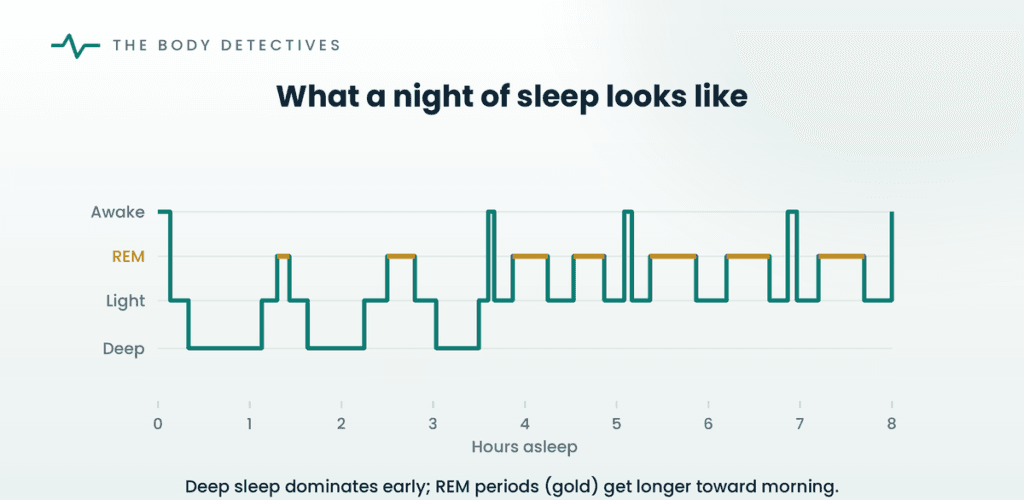
You don’t move neatly from light to deep to REM and stop — you loop through them. Early cycles are rich in deep sleep, which is why the first few hours are so restorative. As the night goes on, deep sleep fades and REM periods grow longer, so the last cycles before waking are REM-heavy. This is also why cutting your night short robs you mostly of REM.
How much sleep do you need?
Sleep needs change across life. As a rough guide:
- Newborns: 14–17 hours
- School-age children: 9–11 hours
- Teenagers: 8–10 hours
- Adults: 7–9 hours
- Older adults: 7–8 hours
Most healthy adults do best with seven to nine hours. Regularly getting less than seven is linked to higher risks to heart, metabolic, and mental health, while consistently needing far more than nine can sometimes signal an underlying issue worth checking. For practical sleep advice, the NHS is a reliable source.
Quality matters as much as quantity
Spending eight hours in bed doesn’t guarantee good sleep. Sleep apnoea, alcohol, late caffeine, irregular schedules, and stress all fragment your night and eat into deep and REM sleep — so you can clock the hours yet still wake unrefreshed. Trackers estimate your stages from movement and heart rate; they’re handy for spotting trends, but they’re an approximation, not a medical sleep study. Your heart rate variability and resting heart rate overnight can add useful context.
How to get more deep and REM sleep
- Keep a consistent sleep and wake time, even at weekends
- Get daylight in the morning and dim the lights in the evening
- Avoid caffeine late in the day and alcohol close to bedtime
- Keep your bedroom cool, dark, and quiet
- Wind down with a screen-free routine before bed
When to see a doctor
See your doctor if you regularly wake unrefreshed despite enough hours, snore loudly or gasp in your sleep (possible sleep apnoea), struggle to fall or stay asleep most nights, or feel very sleepy during the day. These are common, treatable problems — not something to simply push through.
The bottom line
Your sleep stages aren’t trivia — they’re the building blocks of how you recover each night. Light sleep sets the foundation, deep sleep rebuilds your body, and REM restores your mind. Aim for a consistent seven to nine hours, protect your routine, and treat your tracker’s stage breakdown as a helpful trend rather than a verdict.
This article is for general educational purposes only and is not a substitute for professional medical advice. If you have ongoing problems with your sleep, please speak to your own doctor. See our Medical Disclaimer for more information.