How Many Steps a Day Do You Really Need?
If your watch nags you to hit 10,000 steps a day, here’s some freeing news: that number was never based on science. It came from a 1960s marketing campaign, not a study. So how many steps a day do you really need? Research now points to a more achievable answer — and to the reassuring fact that every extra bit of walking counts, even if you never reach five figures. This guide explains where 10,000 came from, what the evidence actually shows, and how to set a step goal that suits you.
Where did 10,000 steps come from?
The 10,000-step target is one of the most successful pieces of marketing in fitness history. In the run-up to the 1964 Tokyo Olympics, a Japanese company sold a pedometer called the manpo-kei — literally “ten-thousand-step meter”. The round number stuck, spread worldwide, and was later built into fitness trackers and apps. It’s a memorable goal, but it was chosen because it sounded good, not because 10,000 was found to be a magic threshold for health.
What the science actually says
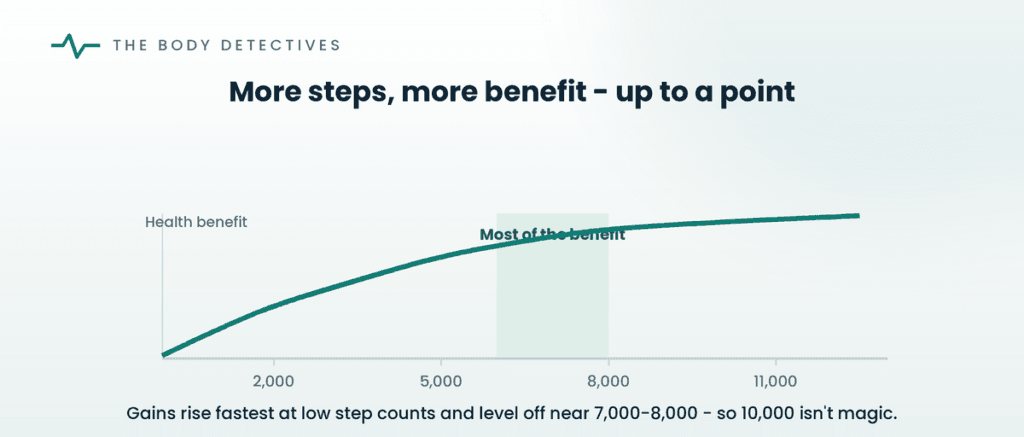
When researchers measured real step counts against health outcomes, a clearer — and gentler — picture emerged:
A large analysis in The Lancet Public Health found that the risk of dying early falls steadily as daily steps rise, but the benefit levels off at around 6,000 to 8,000 steps for older adults and 8,000 to 10,000 for younger ones. Other studies agree: most of the gains for your heart, brain, and longevity arrive by roughly 7,000 to 8,000 steps a day. Beyond that, more steps still help a little, but with diminishing returns.
Daily step count guide
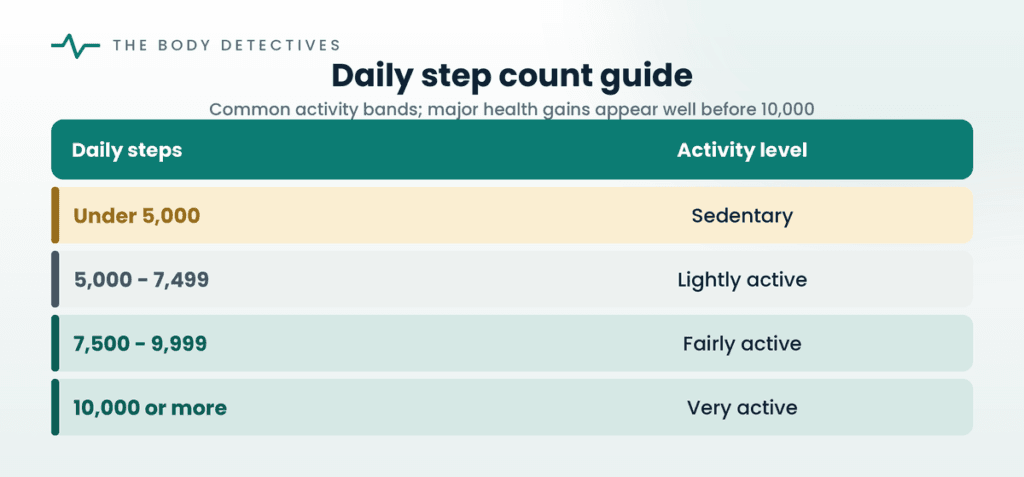
Step counts are often grouped into broad activity levels:
These bands are useful for seeing where you sit, but don’t be discouraged if you’re in a lower one. The single biggest health jump comes from leaving the “sedentary” zone — going from around 2,000–3,000 steps to 5,000 or more makes a striking difference.
How many steps should you aim for?
For most adults, a target of around 7,000 to 8,000 steps a day is a sensible, evidence-based goal that captures the lion’s share of the benefits. If you’re older or just starting out, 6,000 — or even fewer — is genuinely worthwhile. The best target is one you’ll actually hit consistently: if you currently walk 3,000 steps, aiming for 5,000 is far more useful than chasing 10,000 and giving up. As a rule of thumb, adding 1,000 to 2,000 steps to your current average is a great place to start.
Do steps tell the whole story?
Steps are a brilliantly simple measure, but they aren’t everything. Intensity matters too — a brisk walk that lifts your heart rate into a higher training zone does more than the same number of slow, shuffling steps. Total daily movement, including activity that doesn’t register as “steps” such as cycling or swimming, also counts. And bear in mind that wrist and phone counters are only estimates, often out by 10 to 30%, so treat the exact figure as a guide rather than gospel.
When to see a doctor
Walking is safe for almost everyone, but check with your doctor before ramping up activity if you have a heart condition, chest pain on exertion, severe breathlessness, dizziness, or significant joint problems. And if everyday walking suddenly becomes much harder than usual, that’s worth getting looked at rather than simply pushing through.
The bottom line
You don’t need 10,000 steps a day to be healthy — that figure was a marketing slogan, not a prescription. The evidence suggests most of the benefit arrives by about 7,000 to 8,000 steps, and even modest amounts of walking meaningfully lower your health risks. So pick a realistic target, build up gradually, and remember that the most important step count is the one you can keep doing.
This article is for general educational purposes only and is not a substitute for professional medical advice. Always consult your own doctor before starting a new exercise programme, especially if you have a health condition. See our Medical Disclaimer for more information.