

CRP Levels: What Your C-Reactive Protein Test Means
Your CRP levels are one of the simplest windows into inflammation anywhere in your body. C-reactive protein (CRP) is made by your liver and rises within hours of an infection, injury, or flare of inflammation — which is why doctors order it so often. This guide explains what your CRP level means, the difference between a brief spike and the low-grade kind linked to heart disease, what pushes it up, and when to get checked.
What is C-reactive protein (CRP)?
C-reactive protein is a protein your liver releases into the blood as part of the immune response. When tissue is damaged or infected, immune signals tell the liver to make more of it, so the level acts like a thermometer for inflammation. It’s a sensitive marker but a non-specific one: a high CRP tells you inflammation is present somewhere, not exactly where or why. For a plain-language overview of the test, MedlinePlus, from the US National Library of Medicine, is a reliable source.
Normal CRP levels
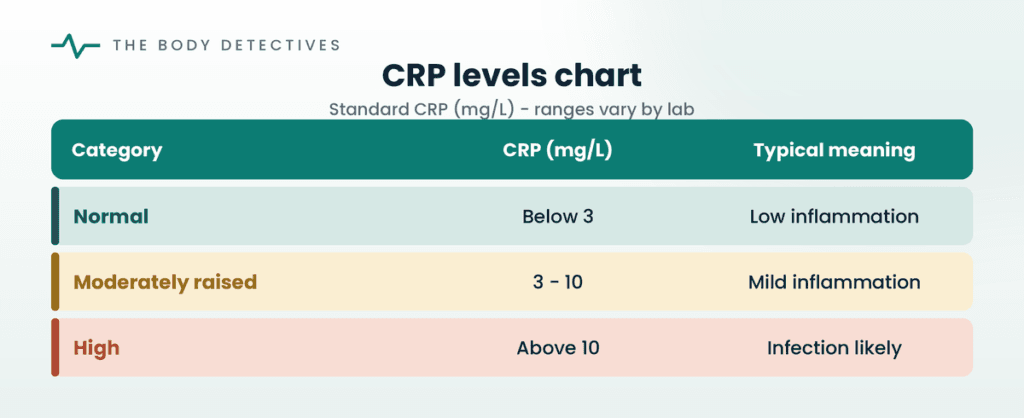
CRP is measured from a simple blood sample and reported in milligrams per liter (mg/L). The guide below shows how standard CRP levels are usually read, though exact cut-offs vary between laboratories.
| Category | CRP (mg/L) | Typical meaning |
|---|---|---|
| Normal | Below 3 | Low inflammation |
| Moderately raised | 3–10 | Mild inflammation |
| High | Above 10 | Infection likely |
A reading above about 10 mg/L usually points to significant inflammation or an infection, and very high levels (often above 50–100 mg/L) are common with bacterial infections. Because one result can be thrown off by a recent cold or injury, doctors look at the trend rather than a single number.
hs-CRP and your heart-disease risk
A more sensitive version, called high-sensitivity CRP (hs-CRP), can measure very low levels and helps estimate the risk of heart disease. The American Heart Association uses these rough bands:
| hs-CRP (mg/L) | Heart-disease risk |
|---|---|
| Below 1.0 | Lower risk |
| 1.0–3.0 | Average risk |
| Above 3.0 | Higher risk |
For heart-risk purposes the test is best done twice, about two weeks apart, when you’re well — and a reading above 10 mg/L is treated as a sign of active inflammation rather than a heart-risk score.
Two kinds of a raised CRP
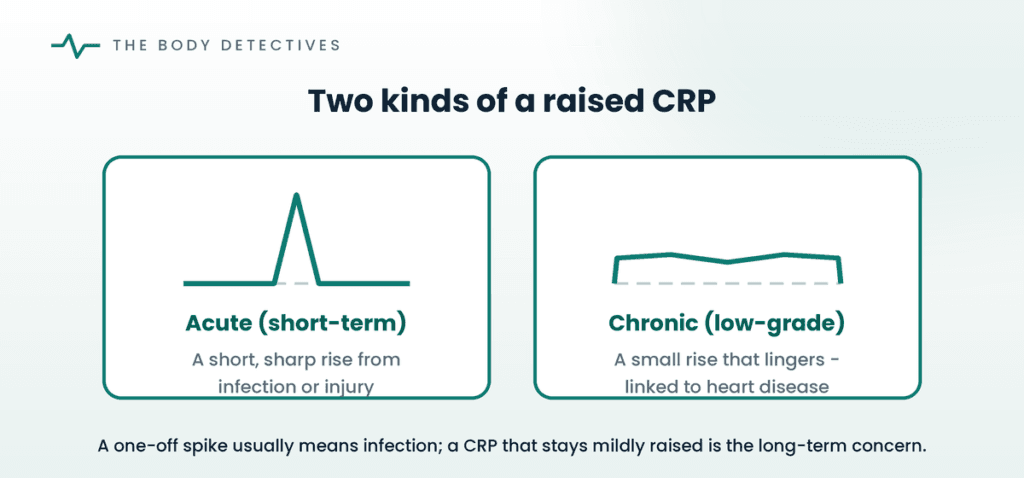
It helps to picture CRP behaving in two very different ways. An acute rise is a tall, brief spike from an infection or injury that settles as you recover. A chronic, low-grade rise is a small elevation that lingers — and it’s this persistent kind, driven by things like excess weight, smoking, and poor metabolic health, that is linked to long-term cardiovascular risk alongside markers such as cholesterol.
What causes a high CRP?
- Infections, especially bacterial ones
- Injuries, surgery, or burns
- Autoimmune and inflammatory diseases such as rheumatoid arthritis
- Carrying excess weight, particularly around the middle
- Smoking
- Poorly controlled diabetes — see our guide to blood sugar levels
- A temporary rise after very intense exercise
How to lower chronic inflammation
- Reach and keep a healthy weight
- Don’t smoke
- Stay physically active
- Eat more vegetables, fruit, whole grains, and healthy fats, and less ultra-processed food
- Manage conditions like diabetes and high blood pressure
- Get enough good-quality sleep
Treating any underlying cause is the most important step, because a persistently raised CRP usually reflects something else going on.
When to see a doctor
A raised CRP found on a blood test should always be interpreted by your doctor alongside your symptoms and other results. Seek prompt care if a high CRP comes with signs of infection — fever, severe pain, a spreading area of red skin, or feeling very unwell. If your CRP is mildly and persistently raised without an obvious cause, your doctor may look more closely at your heart and metabolic health.
The bottom line
CRP is a quick, useful signal that inflammation is present, but it never tells the whole story on its own. A one-off high reading usually reflects an infection or injury that passes, while a mildly raised level that stays up is worth taking seriously for your long-term health. Your doctor uses CRP alongside the rest of your picture to find what’s driving it.
This article is for general educational purposes only and is not a substitute for professional medical advice. Always consult your own doctor about test results or before making changes to your health routine. See our Medical Disclaimer for more information.