PSA Levels by Age: What a High PSA Really Means
PSA levels are among the most talked-about — and most misunderstood — numbers in men’s health. PSA stands for prostate-specific antigen, and a raised result can set off real alarm, because in most people’s minds the test is tied directly to prostate cancer. But here is the single most important thing to know before you read your number: a high PSA is not a cancer diagnosis. Far more often, it points to something completely benign. Here is what PSA actually measures, what the numbers mean by age, and why a raised result is a reason to look closer — not to panic.
What PSA actually is
PSA is a protein made by the prostate — a small gland that sits just below the bladder in men and helps produce semen. Both healthy prostate cells and, sometimes, cancerous ones make it, and a little naturally leaks into the bloodstream. The PSA test simply measures how much is there, reported in nanograms per millilitre (ng/mL). Because most prostate problems push extra PSA into the blood, the test works as an early-warning flag: useful, but non-specific. It tells you that something may be going on with the prostate — not what.
What counts as normal PSA levels
There is no single magic cut-off, and the thinking has shifted over the years. For a long time a level below 4.0 ng/mL was treated as “normal” and anything above it as suspicious — but that one-size-fits-all line missed some cancers and raised needless alarm in other men. Today many labs use age-adjusted ranges, because PSA naturally creeps up as the prostate enlarges with age. A common guide looks roughly like the chart below, though your own lab and doctor may use different thresholds.
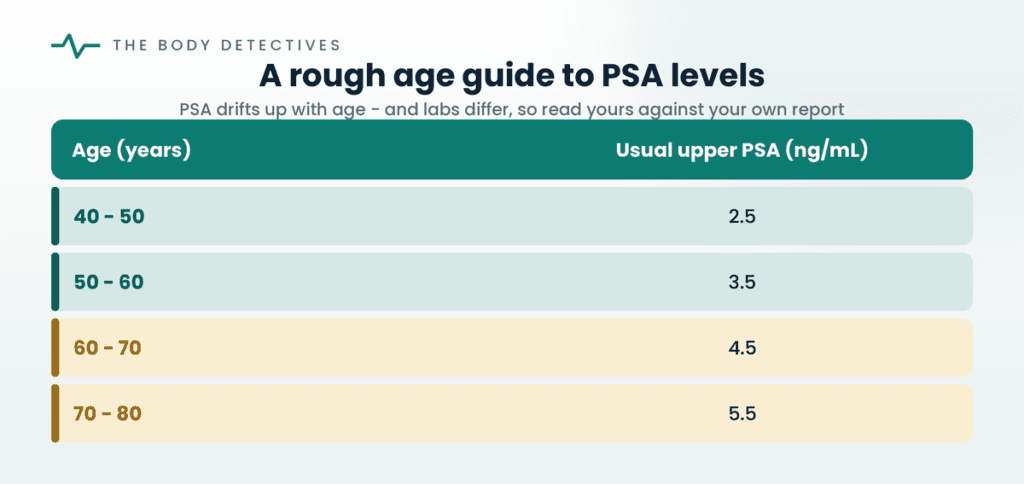
Whatever the figure, a single result rarely tells the whole story. Doctors weigh your age, how the number is trending over time, your symptoms and your risk factors together — which is exactly why a PSA result is meant to start a conversation, not end one.
A high PSA usually isn’t cancer
This is the part that saves a lot of sleepless nights. Plenty of harmless, common conditions raise PSA. The most frequent is benign prostatic hyperplasia — a non-cancerous enlargement of the prostate that is almost a normal part of ageing. Local inflammation or infection of the prostate (prostatitis), a urinary infection, a recent catheter, vigorous cycling, and even recent ejaculation can all nudge the number up for a while. Treatments matter too: testosterone therapy can raise PSA, while common prostate-shrinking drugs lower it.
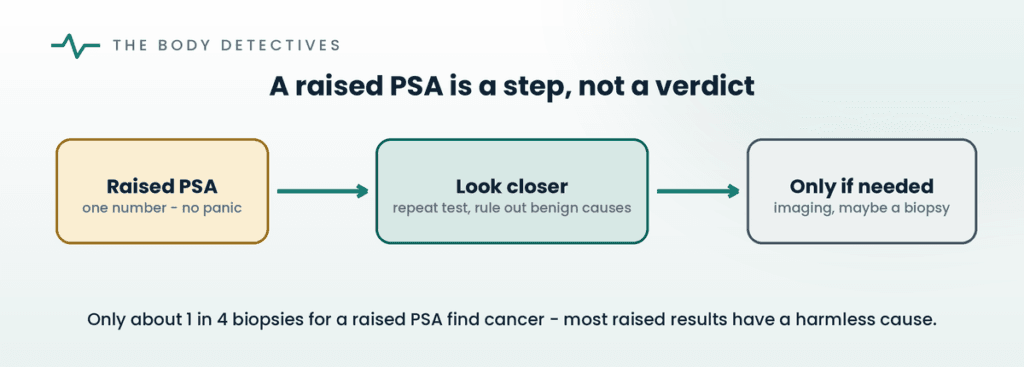
The numbers back this up. According to the National Cancer Institute, only about one in four men who have a biopsy because of a raised PSA actually turn out to have prostate cancer — so most raised results are false alarms. That is precisely why a high PSA leads to a careful, step-by-step look rather than a straight leap to a diagnosis.
When to see a doctor
PSA is most useful as part of a planned conversation, not a surprise. If you are in your fifties — or younger if prostate cancer runs in your family, or you are of African descent, both of which raise the baseline risk — it is worth asking your doctor whether PSA testing is right for you, and how often. Screening is a personal decision with genuine pros and cons, and a good doctor will walk you through both sides. Separately, see a doctor promptly if you have trouble passing urine, a weak stream, a frequent need to go at night, blood in your urine or semen, or new bone pain — whether or not you have ever had a PSA test.
The bottom line
PSA is a helpful early-warning flag for the prostate, not a cancer test in its own right. A raised level is common, usually has a benign explanation, and calls for a calm, stepwise look with your doctor rather than panic. Know your number, understand that it rises naturally with age, and treat it as the start of a conversation — one that, when it truly matters, can catch a serious problem early.
This article is for general educational purposes only and is not a substitute for professional medical advice, diagnosis or treatment. PSA testing and prostate cancer screening are personal decisions with both benefits and risks, and reference ranges vary between laboratories. Always discuss your own result, symptoms and screening choices with a qualified doctor. If you have urinary symptoms, blood in your urine, or other concerns, seek medical advice. See our Medical Disclaimer for more information.