
Heart Rate Recovery: How Fast Your Pulse Should Drop
Heart rate recovery is one of the most telling numbers your smartwatch quietly records, yet few people know to look at it. It is not about how low your pulse goes, but how quickly it comes back down after you stop exercising. Push your heart rate up on a run or a flight of stairs, then either keep walking slowly or sit down: the speed at which it falls over the next minute is a real-time readout of your fitness and of your nervous system’s “brake”. A fast drop is a good sign; a sluggish one is worth paying attention to. Here is what heart rate recovery is, what your number means, and how to improve it.
What heart rate recovery is
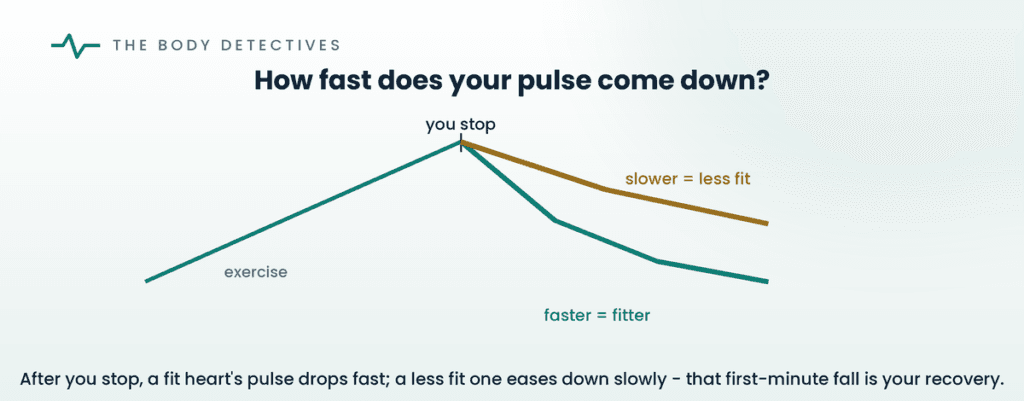
Heart rate recovery is simply the difference between your peak heart rate at the end of exercise and your heart rate one minute after you stop, measured in beats per minute. If your pulse hit 160 at the top of a climb and settled to 140 a minute later, your recovery is 20 beats. Why it works as a health signal lies in your autonomic nervous system: during exercise your body’s “accelerator” drives the heart, and the moment you stop, the “brake” — the parasympathetic system, carried by the vagus nerve — should kick back in and slow things down. The diagram below shows the idea.
Why a faster drop is better
That quick return of the brake is what a healthy heart rate recovery reflects — and it tracks closely with fitness. Well-conditioned people see their pulse tumble rapidly; a slow decline suggests the parasympathetic system is less responsive, which tends to go hand in hand with lower fitness. It matters beyond the gym, too: research links a poor recovery to a higher risk of heart and metabolic problems. Like your resting heart rate and heart rate variability, it is a window onto the autonomic system that runs quietly in the background. The chart below gives a rough guide to the one-minute drop.
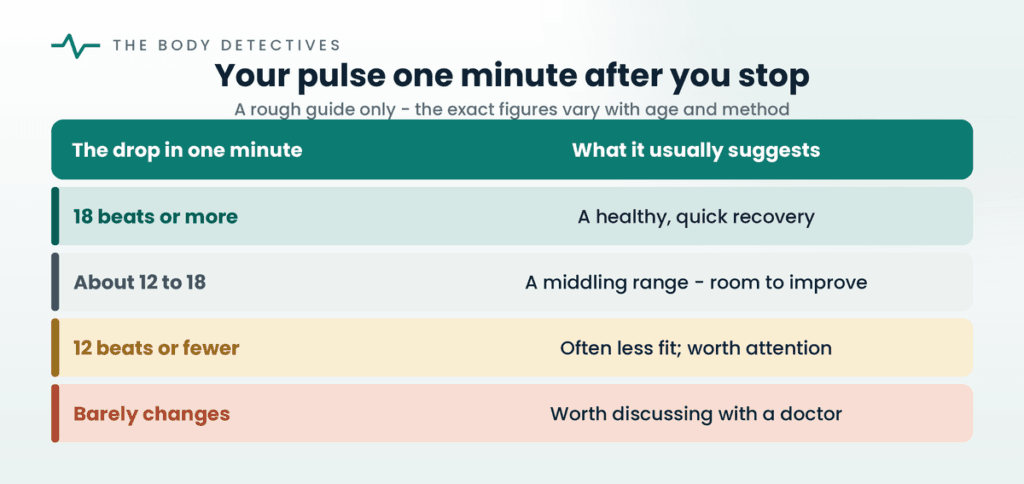
Treat those numbers as a guide rather than a verdict. The exact figures shift with your age, how hard you pushed, and whether you kept walking or stood completely still — so the most useful thing is not a single reading but the trend: as your fitness improves, your recovery should quicken.
When to see a doctor
Heart rate recovery is a wellness signal, not a diagnosis, and the best response to a slow one is usually more regular aerobic exercise — the single most reliable way to improve it. See a doctor, though, if your recovery is consistently very poor, if it worsens over time despite training, or if it comes with symptoms such as chest pain, breathlessness beyond what the effort warrants, dizziness or an irregular pulse. And as always, check with your doctor before starting a new exercise programme if you have a heart condition or have been inactive for a long time.
The bottom line
Heart rate recovery turns the moment after exercise into a simple fitness test: the faster your pulse falls, the more responsive your heart and nervous system. A drop of more than 12 beats in the first minute if you keep walking slowly, or more than 18 if you stop and rest completely, is a reassuring sign, and the number tends to improve the fitter you get. You do not need a lab to track it — just your pulse, a clock, and the minute after you stop. Watch the trend, keep moving, and let a persistently poor recovery be the prompt to get checked.
This article is for general educational purposes only and is not a substitute for professional medical advice, diagnosis or treatment. If you have a heart condition, chest pain, or an irregular or very slow-recovering pulse, or before beginning a new exercise programme, speak to your own doctor. See our Medical Disclaimer for more information.


Really helpful and clear breakdown! I’ve been tracking my recovery heart rate after workouts recently, and this explained exactly what numbers to look for. Keep up the great work!