Respiratory Rate: Normal Range by Age and More
Your respiratory rate — how many breaths you take in a minute — is one of the four classic vital signs, alongside your heart rate, blood pressure, and temperature. It’s also one of the most revealing: breathing often speeds up before anything else when the body is under strain, which makes it an early warning sign that doctors watch closely. Yet most of us never give it a thought. This guide explains what a normal respiratory rate is, how it changes with age and activity, and what unusually fast or slow breathing can mean.
What is respiratory rate?
Respiratory rate is simply the number of breaths you take per minute while at rest. It’s controlled automatically by your brainstem, which adjusts your breathing to keep oxygen and carbon dioxide in balance — though, unusually for a vital sign, you can also override it consciously by holding your breath or breathing faster. It’s measured by counting how many times your chest rises in a minute, and some wearables now estimate it for you overnight. For more, the American Lung Association is a reliable source.
Normal respiratory rate by age
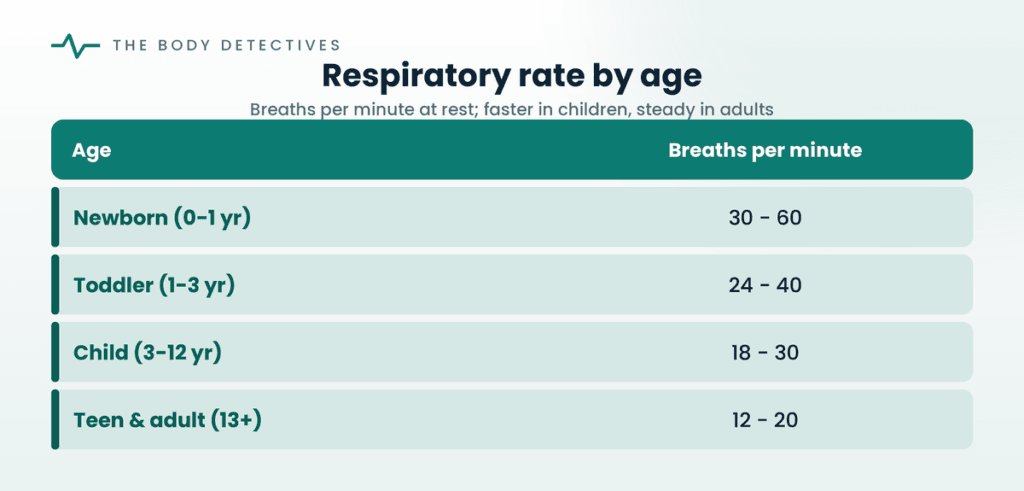
Like your heart rate, your breathing rate is fastest in babies and settles to a steady adult range as you grow.
For a healthy adult at rest, 12 to 20 breaths per minute is the usual range. Children breathe considerably faster, and a newborn’s rate can be three times an adult’s — all completely normal.
How activity changes your breathing
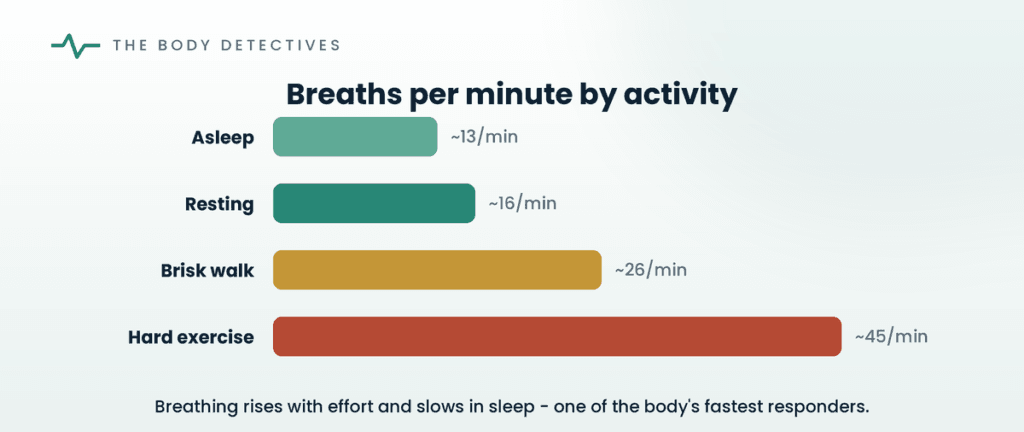
Your respiratory rate isn’t fixed — it rises and falls minute to minute to match what your body needs:
During exercise, your muscles demand more oxygen and produce more carbon dioxide, so your breathing speeds up to keep pace. In deep sleep, when your needs are lowest, it slows right down. Stress, fever, and even a big meal can nudge it up too — which is why a reading taken just after rushing to an appointment isn’t a fair measure.
What fast breathing means (tachypnoea)
Persistently fast breathing — more than about 20 to 25 breaths per minute in an adult at rest — is called tachypnoea. It’s often a normal response to exercise, but at rest it can signal that the body needs more oxygen or is trying to clear excess acid. Common causes include fever, anxiety, pain, asthma or other lung conditions, and a low blood oxygen level. Because breathing is such a sensitive early signal, a rising rate is taken seriously in anyone who is unwell.
What slow breathing means (bradypnoea)
Breathing slower than about 12 breaths per minute at rest is called bradypnoea. A slightly low rate can be perfectly normal during sleep or in very fit people, but an abnormally slow rate can mean the body isn’t moving enough air. Causes include certain medicines — particularly opioids and sedatives, which suppress the brain’s breathing centre — as well as some neurological conditions. A very slow or irregular breathing pattern needs urgent attention.
How to measure it
To check your own rate, sit quietly for a few minutes, then count your breaths for a full 60 seconds — one rise and fall of the chest counts as a single breath. Counting for the whole minute is more accurate than counting for fifteen seconds and multiplying. It helps to do it without thinking about it too much, since simply paying attention to your breathing tends to change it.
When to see a doctor
Seek urgent help for breathing that’s very fast or very slow at rest, breathlessness that comes on suddenly or at rest, blue-tinged lips or fingertips, chest pain, or being unable to speak in full sentences. In children, fast breathing with flaring nostrils, grunting, or the skin pulling in around the ribs is a red flag. Any breathing change that worries you, especially with other symptoms, is worth getting checked.
The bottom line
Your respiratory rate is a quiet but powerful vital sign — a real-time readout of how hard your body is working. For most adults at rest it sits between 12 and 20 breaths a minute, rising with activity and illness and falling in sleep. Because changes in breathing often appear early, a rate that’s persistently outside the normal range, or paired with breathlessness, always deserves a closer look.
This article is for general educational purposes only and is not a substitute for professional medical advice. Always consult your own doctor about breathing problems or any concerning symptom. See our Medical Disclaimer for more information.