Iodine: The Tiny Mineral Your Thyroid Is Made From
Iodine is one of the smallest entries on any nutrition label and one of the most important — because without it, your thyroid simply cannot make its hormones. This trace mineral has a single, non-negotiable job: it is the raw material your body builds thyroid hormones from, and those hormones set the pace of your entire metabolism. Get too little and your thyroid struggles; get far too much and, oddly, you can run into similar trouble. Here is what iodine does, how much you need, and who most needs to pay attention.
What iodine does in your body
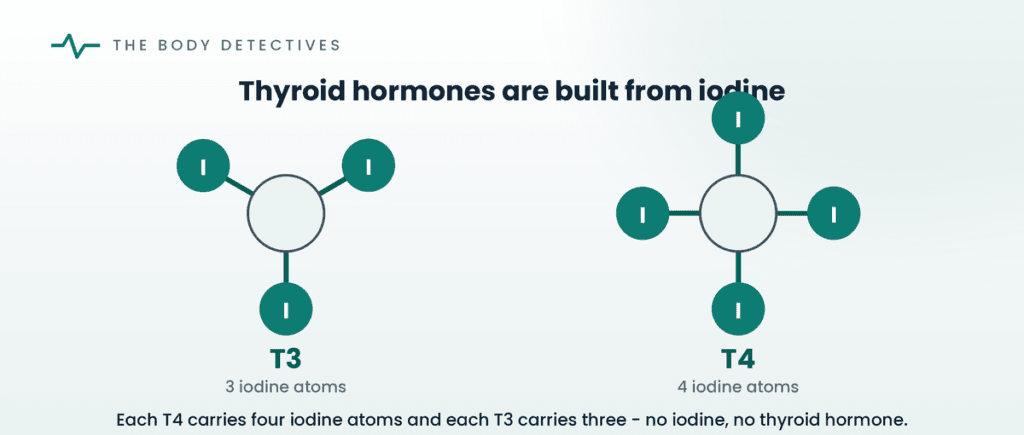
Iodine has essentially one starring role: it is the building block of your thyroid hormones. Your thyroid combines iodine with a protein to make two hormones — T4 and T3 — which then travel around your body controlling how fast you burn energy, how warm you feel, your heart rate and even your mood. The names give the chemistry away: T4 (thyroxine) carries four iodine atoms and T3 carries three. No iodine, no thyroid hormone — it really is that direct, as the diagram below shows.
How much iodine you need
Your daily requirement is tiny — measured in micrograms, not milligrams — but it climbs during pregnancy and breastfeeding, when a developing baby depends on it too. The chart below shows the recommended daily intake by group.
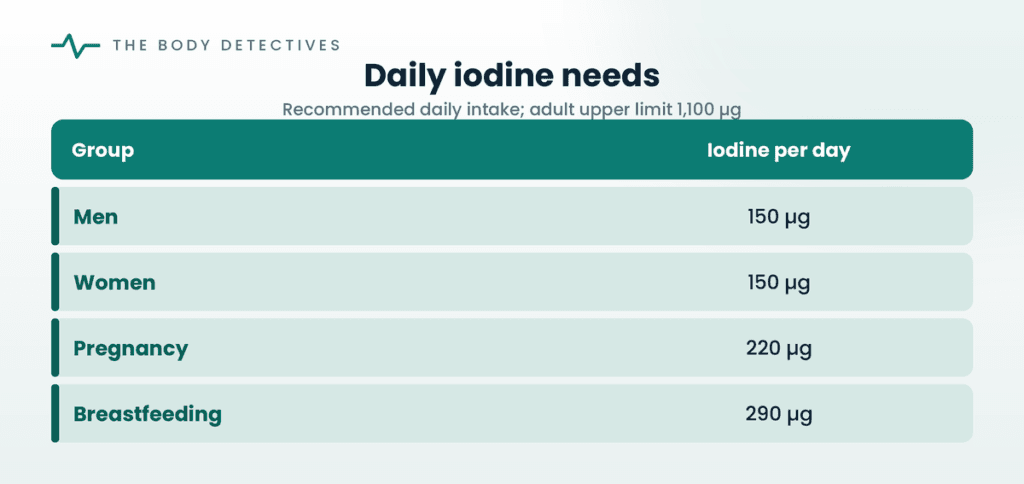
Most people meet these targets without ever thinking about it, largely thanks to one quiet public-health success story: iodised salt. Iodine is also found in seafood, seaweed, dairy and eggs. Seaweed in particular can be extraordinarily rich — sometimes so rich that a single serving overshoots the safe limit.
Why iodine deficiency still matters
For decades, iodine deficiency was the world’s leading preventable cause of brain damage, which is exactly why so many countries add iodine to table salt. When intake falls short, the thyroid swells as it strains to capture every scrap of iodine — a visible enlargement in the neck known as a goitre. The stakes are highest in pregnancy: a developing baby relies on the mother’s iodine for healthy brain and nervous-system development, and a serious shortfall can cause lasting harm. Even mild deficiency in adults can dull concentration and energy.
Can you have too much iodine?
Yes — and this catches people out. Because the thyroid is so finely tuned, flooding it with iodine (usually from high-dose supplements or large amounts of seaweed and kelp) can disturb it just as a shortage does, sometimes tipping it into an overactive or underactive state. This is why iodine works best from a balanced diet rather than aggressive supplementation — and why selenium matters here too, since the two minerals work as a team for a healthy thyroid.
When to see a doctor
See a doctor if you notice a swelling at the front of your neck, or symptoms of a thyroid problem such as unexplained tiredness, weight change, feeling unusually hot or cold, or a change in your heart rate. If you are pregnant, planning a pregnancy or breastfeeding, ask your doctor or midwife whether you are getting enough iodine, as your needs are higher at these times. And be cautious with iodine or kelp supplements — more is not safer, and it is surprisingly easy to overshoot.
The bottom line
Iodine is a tiny mineral with one enormous responsibility: it is the raw material your thyroid hormones are made from, which is why both too little and too much can throw your metabolism off balance. For most people, iodised salt and a normal varied diet do the job quietly and well. If you are pregnant or breastfeeding it deserves a little extra attention, and if you are tempted by high-dose supplements it deserves a little extra caution. To understand the hormones it builds, it helps to read up on your thyroid hormones.
This article is for general educational purposes only and is not a substitute for professional medical advice, diagnosis or treatment. Always speak to your own doctor about your health and before changing your diet or supplements. See our Medical Disclaimer for more information.