Wrist Temperature: What Your Smartwatch Is Really Telling You
Wrist temperature has quietly become one of the most talked-about numbers on modern smartwatches and rings, measured while you sleep and then tracked night after night. Yet it is also one of the most misunderstood. It is not the same as taking your temperature with a thermometer, and a single reading tells you almost nothing on its own. Its real value lies in the trend — how tonight compares with your own normal. Here is what wrist temperature actually measures, what a change in it can mean, and when it is worth a second look.
What wrist temperature actually measures
The figure your watch reads at the wrist is your skin temperature, not the core temperature deep inside your body that a clinical thermometer estimates. Skin temperature sits lower and moves around far more, because it rises and falls with your surroundings — a warm duvet, a hot bedroom or a cold night all shift it. That is exactly why wearables measure it overnight, when conditions are steadiest, and why they report the change from your personal baseline rather than the raw number. The diagram below shows the idea.
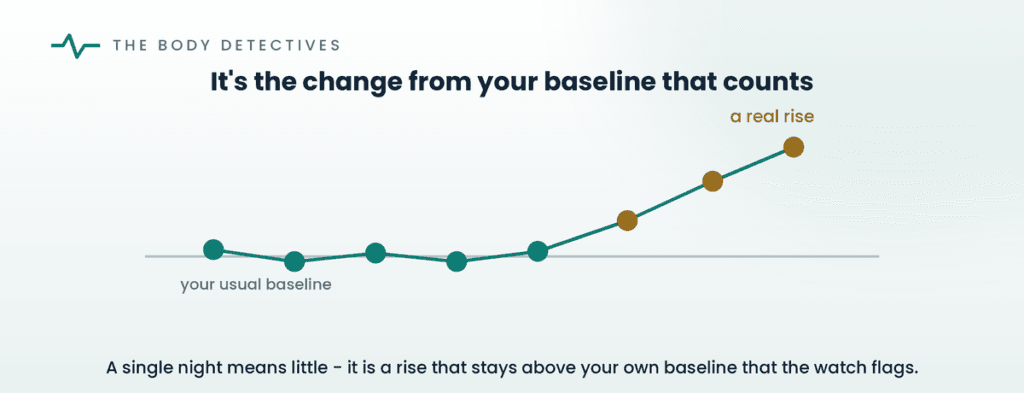
Most devices need around five nights to learn your usual overnight pattern before they will show you anything. After that, they watch for departures from it. Like your resting heart rate and heart rate variability, wrist temperature is judged against your own history, not a fixed normal — which is why a reading a fraction of a degree above baseline for one night is just noise, while the same rise held across several nights is what the algorithms flag.
What a change can mean
Because skin temperature tracks so closely with your body’s state, a sustained shift can be an early clue to several things. The chart below lays out the common ones.
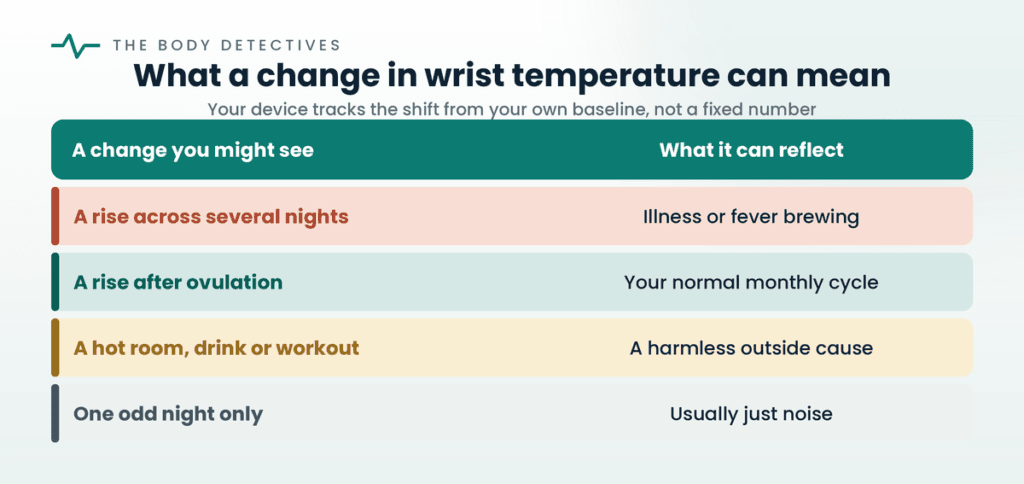
The signal people find most useful is illness: wrist temperature often creeps up a night or two before you feel unwell, as your body gears up to fight something off, and some notice it before any other symptom. In those who menstruate, it also rises in the second half of the cycle after ovulation, which is why the same devices can help with cycle tracking. The catch is that plenty of harmless things — a hot room, a late drink, a hard workout — nudge it too, so context always matters.
When to see a doctor
Wrist temperature is a wellness feature, not a medical device — Apple is clear that it is not a thermometer and cannot tell you whether you have a fever. So treat a raised reading as a prompt, not a diagnosis. If you feel unwell, check your actual temperature with a real thermometer and judge it by your symptoms rather than the graph. See a doctor for a high fever, a fever that lasts beyond a few days, or any temperature change that comes with breathlessness, a stiff neck, confusion or a rash — those need proper assessment, whatever your watch says.
The bottom line
Wrist temperature is a clever trend tool rather than a thermometer on your arm. Its strength is spotting when tonight drifts away from your own baseline, which can flag illness early or follow your monthly cycle — but it cannot, by itself, tell you that you are ill or measure a fever. Read it as one gentle signal among many, confirm anything worrying with a real thermometer, and let how you actually feel have the final word.
This article is for general educational purposes only and is not a substitute for professional medical advice, diagnosis or treatment. A wearable is not a medical device; if you feel unwell or are worried about a fever, check with a proper thermometer and speak to your own doctor. See our Medical Disclaimer for more information.