Growth Hormone: What It Really Does, and Why Sleep Matters
Growth hormone has a reputation it does not quite deserve — sold as an anti-ageing miracle by some, feared by others, yet genuinely vital to how your body grows and runs. Made by the pituitary gland, this single hormone does very different jobs depending on your age: in childhood it builds your height, and in adulthood it quietly helps run your metabolism and shape your body. Here is what growth hormone actually does, what high and low levels mean, and the simple daily habit that affects it most.
What growth hormone does
Growth hormone is released by the pituitary gland, a pea-sized control centre at the base of your brain. In children and teenagers its headline role is exactly what the name suggests: it drives the growth of bones and tissues and sets your final height. Once the growth plates in your bones fuse in early adulthood, it can no longer make you taller — but its job is far from over. In adults, growth hormone helps maintain healthy body structure and metabolism: supporting muscle and bone, influencing how you store fat, and helping keep blood sugar in a steady range. Much of this work is carried out through a second messenger called IGF-1, which is why doctors often measure IGF-1 alongside it.
Reading a growth hormone result
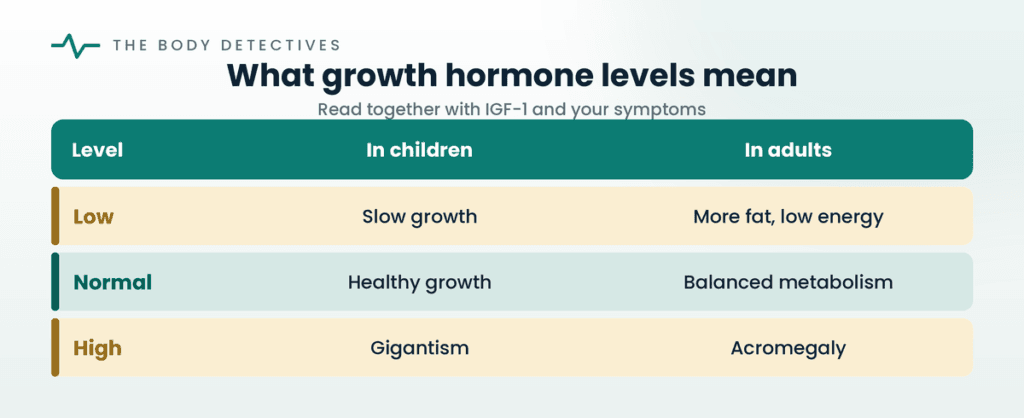
Growth hormone is hard to pin down with a single blood test, because levels rise and fall in bursts all day. So doctors usually interpret it together with IGF-1 and your symptoms, rather than chasing one exact number. The chart below shows what low, normal and high results tend to mean at different ages.
The daily habit that matters most: sleep
One of the most striking things about growth hormone is its rhythm. Rather than trickling out steadily, it is released in pulses every few hours — and by far the largest surge happens during deep sleep. The diagram below shows this pattern across a single day.
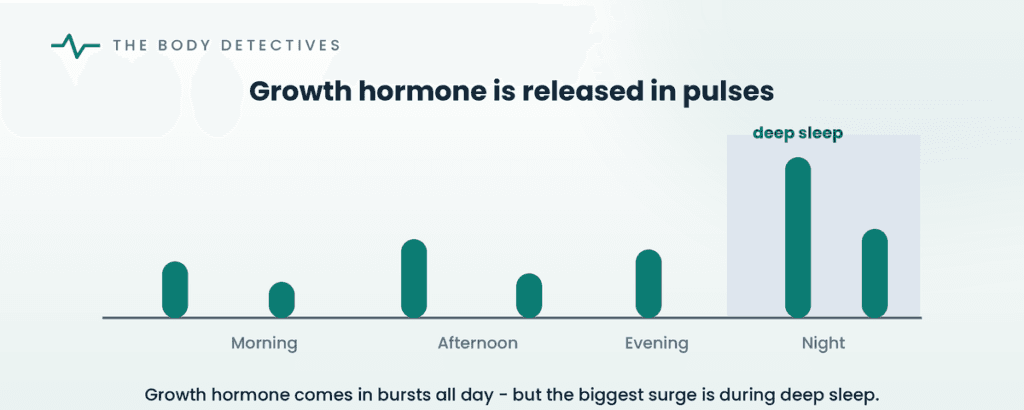
This is not a minor detail. It is one of the clearest reasons why consistent, good-quality deep sleep matters so much for recovery, repair and healthy ageing. Skimp on sleep, and you blunt your body’s single biggest natural release of this hormone.
When growth hormone is too high or too low
Too much growth hormone has dramatic effects. In children, before the bones fuse, it causes gigantism and unusually tall stature. In adults it causes acromegaly, where the hands, feet and facial features slowly enlarge, often alongside raised blood pressure and strain on the heart. Too little does the opposite: poor growth in children, and in adults more body fat, weaker muscles and bones, lower energy, and a higher long-term risk to the heart. Because growth hormone also influences your blood sugar, imbalances can ripple into your wider metabolism too.
When to see a doctor
See a doctor if a child is growing much faster or slower than expected, or if an adult notices a gradual change in the size of their hands, feet or facial features — or finds that rings and shoes no longer fit. Persistent unexplained tiredness, changing body composition and low mood can also be worth investigating. Just as importantly, be very wary of over-the-counter “HGH boosters” and injectable growth hormone sold for anti-ageing or muscle gain: genuine treatment is only for a diagnosed deficiency, under specialist supervision, because the risks of unnecessary use are real.
The bottom line
Growth hormone is one of your body’s master builders — shaping your height as a child and helping run your metabolism as an adult. You cannot meaningfully boost it with a pill, and you do not need to. The most powerful lever you have is also the most natural one: protect your deep sleep, and you protect your body’s biggest, healthiest pulse of this remarkable hormone.
This article is for general educational purposes only and is not a substitute for professional medical advice, diagnosis or treatment. Always speak to your own doctor about your health and before making changes. See our Medical Disclaimer for more information.