
Melatonin: It’s a Signal, Not a Sleeping Pill
Melatonin is the most misunderstood sleep aid on the shelf. Millions swallow it like a sleeping pill and expect to be knocked out — then feel let down when it does not work that way. Here is the shift that changes everything: melatonin is not a sedative. It is your body’s darkness signal — the hormone that quietly tells your brain “it is night now”. Understand that one idea, and almost everything about how to use it — and how not to — falls into place.
What melatonin actually is
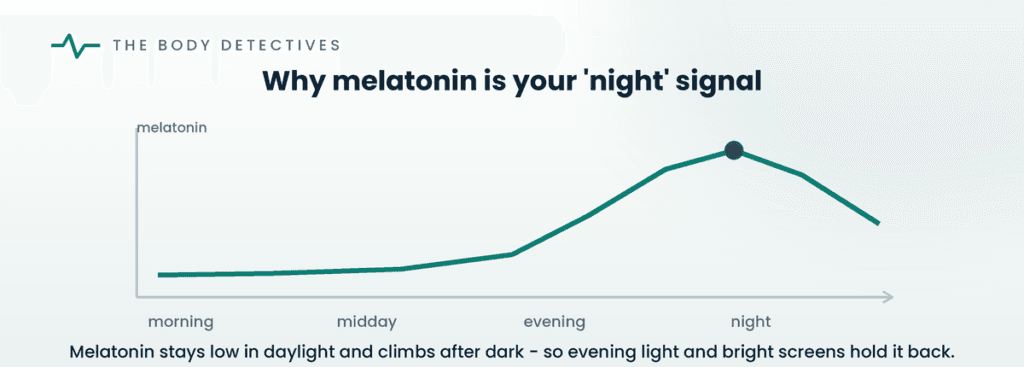
Melatonin is a hormone your brain produces in response to darkness. As the evening draws in and the light fades, a small gland deep in the brain releases it, and levels climb through the night before falling again towards morning. Its job is not to force you unconscious but to set the timing of your body clock — your circadian rhythm — so that sleep and wakefulness land at the right hours. That is also why bright light in the evening, especially the blue light from screens, is such a problem: light suppresses melatonin, and your body reads it as “still daytime”.
What it’s really good for — and what it isn’t
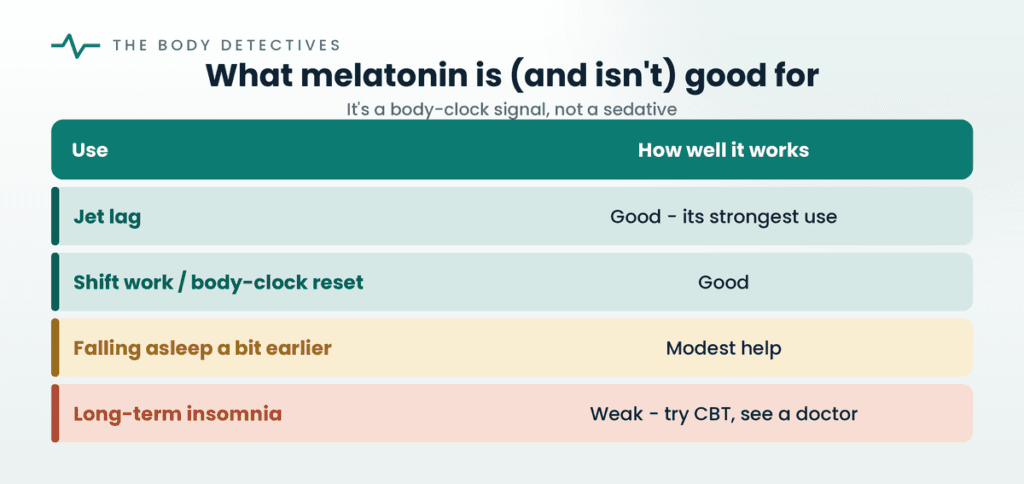
Because melatonin is a timing signal, it shines whenever the problem is a body clock pointing the wrong way. The National Center for Complementary and Integrative Health notes it can genuinely help with jet lag, and taken about an hour before your target bedtime it can nudge a delayed sleep pattern earlier — in one trial, by around half an hour. It is similarly useful for shift workers trying to sleep at odd times. But for classic, long-standing insomnia the picture is different: major sleep bodies find the evidence too weak to recommend it, and favour a talking therapy (CBT for insomnia) instead. Melatonin resets a clock; it does not sedate a racing mind.
Why more is not better
This is where most people go wrong. Melatonin does not work like a painkiller, where a bigger dose means a bigger effect. Studies suggest small amounts — often under 1 mg, and rarely more than 1–3 mg — work just as well as the large 5 or 10 mg doses sold everywhere. Going higher tends to add side effects, not sleep. Timing matters far more than quantity: a low dose taken at the right moment beats a big dose taken at the wrong one. If you are going to use it, start low, take it around 30 minutes to an hour before bed, and keep the room dark so your own natural melatonin can join in.
A word on quality and safety
Two cautions are worth taking seriously. First, quality is patchy: because in the US and some other countries melatonin is sold as a supplement with light regulation, what is on the label may not be what is in the bottle — one 2023 analysis of melatonin gummies found most contained far more than stated, some over three times the labelled amount. In the UK, melatonin is a prescription-only medicine, and the NHS advises against ordering it online. Second, keep it well away from children: accidental melatonin poisonings in children have risen sharply, and it should only ever be given to a child on a doctor’s advice. Side effects in adults are usually mild — headache, grogginess, or vivid dreams — but long-term safety is not well studied.
When to see a doctor
Talk to a doctor before using melatonin if you are pregnant or breastfeeding, if it is for a child, if you have epilepsy or take blood thinners, or if you are on other regular medicines, because it can interact. And if poor sleep is a regular feature of your life rather than the odd bad night, treat that as a reason to be properly assessed — persistent insomnia has causes worth finding, from stress and cortisol patterns to thyroid and mood, and it deserves more than a supplement.
The bottom line
Melatonin is a signal, not a sedative — your body’s way of marking nightfall. Used for the right reasons (jet lag, shift work, a body clock that needs nudging), at the lowest sensible dose and the right time, it can genuinely help. Used as a nightly knockout pill, it usually disappoints. Keep the dose low, mind the quality, keep it away from children, and remember that the basics — a dark room, a steady routine, and healthy levels of nutrients like magnesium — do more for sleep than any tablet. For sleep problems that will not shift, see a doctor.
This article is for general educational purposes only and is not a substitute for professional medical advice, diagnosis or treatment. Melatonin can interact with medicines and is not suitable for everyone; do not give it to a child, or use it in pregnancy, without medical advice. If you have persistent sleep problems, speak to a qualified doctor. See our Medical Disclaimer for more information.