Progesterone Levels: What They Mean by Cycle Phase
Progesterone levels swing dramatically across the menstrual cycle — low in the first half, then surging after ovulation — which is why the timing of a progesterone test matters as much as the number itself. Progesterone is the hormone of your cycle’s second half and the key hormone of early pregnancy, working hand in hand with oestrogen. This guide explains what progesterone does, how its levels change, what high and low results mean, and why it’s so closely tied to ovulation and fertility.
What is progesterone?
Progesterone is a steroid hormone made mainly by the corpus luteum — the temporary gland that forms in the ovary from the empty follicle after an egg is released. Its central job is to prepare and maintain the lining of the womb so that a fertilised egg can implant and grow. It also has whole-body effects, including a slight rise in body temperature and the relaxing of smooth muscle. In pregnancy, the placenta later takes over as the main source. For more, You and Your Hormones is a reliable source.
The two halves of your cycle
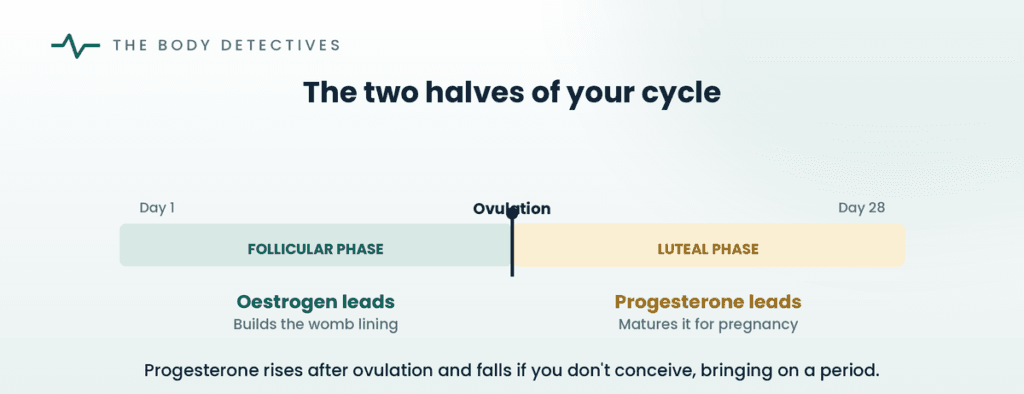
Progesterone makes most sense once you see how it partners with oestrogen across the month:
In the first half (the follicular phase), oestrogen dominates and builds up the womb lining. After ovulation, the corpus luteum produces progesterone, which matures that lining and readies it for a possible pregnancy. If no pregnancy occurs, the corpus luteum breaks down, progesterone falls, and the lining sheds — your period. It’s this monthly rise and fall that drives the cycle.
Progesterone across the cycle
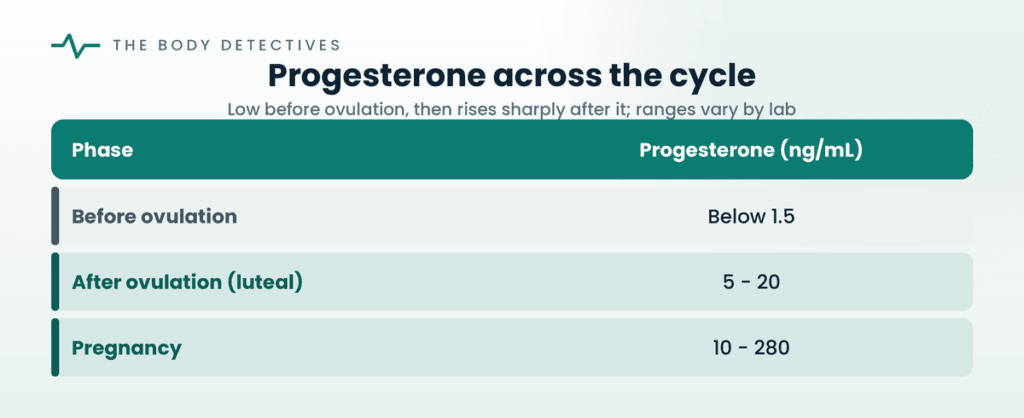
Because of this pattern, a progesterone result can only be read in the context of where you are in your cycle.
This is why a progesterone test is often done about a week after expected ovulation (around day 21 of a 28-day cycle): a clear rise confirms that ovulation has happened.
Progesterone and body temperature
Here’s a neat, practical effect. The progesterone released after ovulation slightly raises your body temperature — by around 0.3°C. Many people use this to track their cycle: a small, sustained rise in waking temperature signals that ovulation has occurred. It’s the same hormone shift, made visible on a thermometer.
What low progesterone means
Low progesterone usually points to a cycle in which ovulation didn’t happen, since without ovulation no corpus luteum forms to produce it — as can occur in polycystic ovary syndrome (PCOS) or with irregular cycles. Low levels can also matter in early pregnancy, where too little progesterone is linked to a higher risk of miscarriage. Signs can include irregular or absent periods and difficulty conceiving.
What high progesterone means
A high progesterone level is most often simply a sign of pregnancy, when levels climb steadily and stay high. Outside pregnancy, it can reflect progesterone-based medication (such as some contraceptives or fertility treatments) or, less commonly, an ovarian cyst. Reassuringly, naturally high progesterone doesn’t cause the kind of problems that some other hormone excesses do.
Progesterone as medication
You’ll also meet progesterone outside the body’s own supply. Synthetic versions, called progestogens or progestins, are widely used — in contraceptive pills, the hormonal coil, and as part of hormone replacement therapy (HRT) for the menopause, usually alongside oestrogen. They’re also given in some pregnancies at risk of early labour. These are prescribed and monitored by a doctor.
When to see a doctor
Consider seeing your doctor if you have irregular, very heavy, or absent periods, are struggling to conceive, or have had recurrent miscarriages — a progesterone test may form part of the assessment. In pregnancy, any bleeding or severe pain should be checked promptly. As always, a single hormone level is interpreted alongside your symptoms, your cycle, and other tests.
The bottom line
Progesterone is the quiet partner of the menstrual cycle — rising after ovulation to prepare the body for pregnancy, then falling away to trigger a period if none occurs. Because its level depends entirely on timing, it’s read in the context of your cycle rather than against a single number. From confirming ovulation to sustaining pregnancy, it’s one of the most important hormones in women’s health.
This article is for general educational purposes only and is not a substitute for professional medical advice. Always consult your own doctor about your cycle, fertility, or hormone results. See our Medical Disclaimer for more information.