Heart Rate Zones: A Simple Guide to Training by Heart Rate
If your fitness watch nudges you about “Zone 2” or splits your workout into coloured heart rate zones, it’s using a simple but powerful idea: the harder you work, the faster your heart beats, and different heart rates train your body in different ways. Heart rate zones turn that relationship into five bands of intensity, each with its own purpose — from gentle recovery to all-out effort. Understanding them helps you train smarter, avoid pushing flat-out every session, and actually reach your goals. This guide explains the five zones, how to find yours, and how to use them.
What are heart rate zones?
Heart rate zones are ranges of intensity defined as a percentage of your maximum heart rate — the fastest your heart can safely beat. Instead of guessing how hard you’re working, your heart rate gives you an objective measure: the higher the percentage of your maximum, the harder your body is working and the more it leans on different energy systems. Most training models, and most wearables, divide effort into five zones from very easy to maximal.
How to find your maximum heart rate
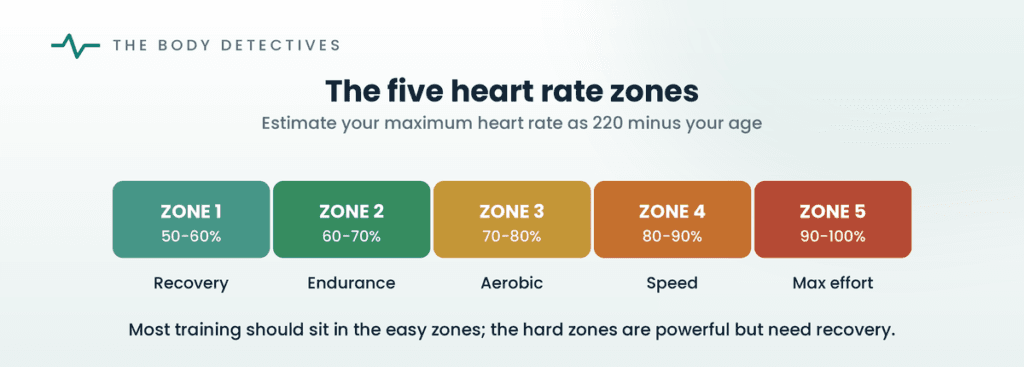
Before you can use zones, you need an estimate of your maximum heart rate. The quickest method is the classic formula: 220 minus your age. So a 40-year-old has an estimated maximum of about 180 beats per minute. It’s only a rough guide — true maximum heart rate can vary by 10 to 20 beats between people of the same age — but it’s good enough to start with. Once you have that number, each zone is simply a percentage band of it. For target heart rate ranges, the American Heart Association is a reliable source.
The five heart rate zones
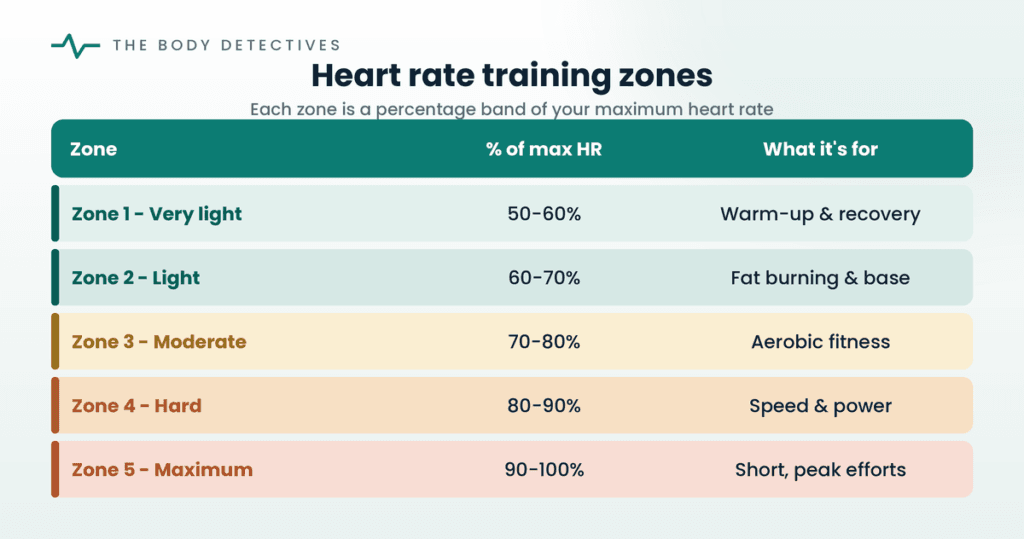
Each of the five zones trains something different:
- Zone 1 (50–60%): Very light effort for warming up, cooling down, and recovery between harder days.
- Zone 2 (60–70%): A comfortable, conversational pace that builds your aerobic base and trains your body to burn fat efficiently. This is where endurance is built.
- Zone 3 (70–80%): A moderate, “somewhat hard” effort that improves general aerobic fitness and stamina.
- Zone 4 (80–90%): Hard work near your threshold, where holding a conversation becomes difficult. It builds speed and performance but is tiring.
- Zone 5 (90–100%): Maximum, all-out effort you can only hold for short bursts, used for peak power and sprint training.
Why most of your training should be easy
It’s tempting to push hard every workout, but research on endurance athletes points the other way. A widely used approach is the 80/20 rule: spend around 80% of your training time in the easy zones (mostly Zone 2) and only about 20% in the hard zones. Easy training builds a big aerobic engine without wearing you down, while a smaller dose of high intensity sharpens speed and power. Going hard all the time tends to leave you tired, stalled, and more prone to injury.
Using zones with a wearable
Watches and chest straps estimate your zones automatically, usually from the 220-minus-age formula, so treat the boundaries as approximate rather than exact. A chest strap is generally more accurate than a wrist sensor, especially during intense or interval workouts. If the numbers seem off, the simple talk test is a great backup: in Zone 2 you can hold a conversation; by Zone 4 you can only manage a few words. Your resting heart rate and heart rate variability can also tell you whether you’ve recovered enough to train hard.
A note on accuracy and safety
Age-based zones are estimates, not precise targets, and they don’t suit everyone. If you take a beta-blocker or another heart-rate-lowering medicine, bpm targets won’t be meaningful — use how hard the effort feels instead. And if you have a heart condition or are new to exercise, check with your doctor before starting harder, higher-zone training.
The bottom line
Heart rate zones are a simple way to make sure your easy days are truly easy and your hard days are hard enough. Estimate your maximum heart rate, aim to spend most of your time in the gentler zones, and save the top zones for shorter, focused efforts. Used sensibly — and with a pinch of salt about the exact numbers — they’re one of the most useful tools your wearable offers.
This article is for general educational purposes only and is not a substitute for professional medical advice. Always consult your own doctor before starting a new exercise programme, especially if you have a health condition. See our Medical Disclaimer for more information.