Selenium: The Tiny Mineral Your Thyroid Can’t Work Without
Selenium is a trace mineral your body needs in only tiny amounts, yet it quietly powers some of your most important systems — from your thyroid to your antioxidant defences. Because you need so little of it, selenium also has one of the narrowest safe windows of any nutrient: too little causes problems, and so does too much. Here is what it actually does, how much you need, and how to spot when your levels have drifted too far in either direction.
What selenium does in your body
Selenium’s main job is to sit at the heart of a family of proteins called selenoproteins, and two of their roles stand out. First, selenium acts as a powerful antioxidant, helping to protect your cells from everyday damage and supporting your immune system. Second — and this is the part most people overlook — your thyroid gland depends on selenium to make and activate its hormones. Gram for gram, your thyroid holds more selenium than any other organ in your body.
How much selenium you need
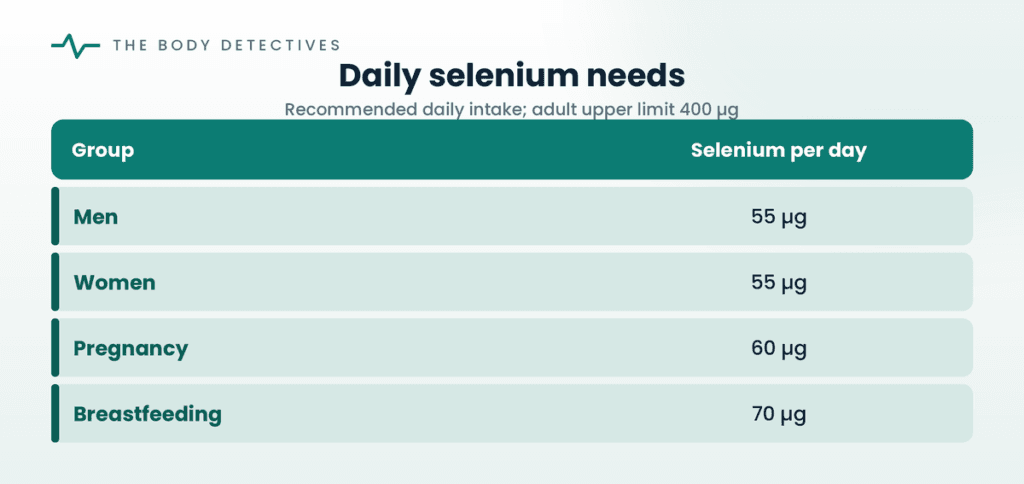
For most adults the recommended daily amount is modest, and the safe upper limit — set by the US National Institutes of Health — is 400 micrograms a day. The chart below shows the recommended daily intake by group.
Most people in well-fed countries comfortably reach these targets through food alone. Selenium is found in Brazil nuts (by far the richest source), seafood, eggs, poultry and whole grains. Just one or two Brazil nuts can supply a whole day’s worth — which is exactly why they deserve respect rather than being eaten by the handful.
Signs of selenium deficiency
True deficiency is rare wherever diets are varied, but it can appear where the soil is low in selenium or in people with conditions that affect absorption. When it does occur, it has been linked to thyroid problems, a heart-muscle condition called Keshan disease, and a joint disorder known as Kashin-Beck disease. Far more commonly, a mild shortfall simply leaves your thyroid and antioxidant systems working with less support than they should have.
Can you have too much selenium?
Yes — and this is where selenium catches people out. Because supplements, and even a few too many Brazil nuts, can push you past the safe limit, getting too much is a genuine risk. The resulting condition, called selenosis, has a memorable early warning: a garlic smell on the breath and a metallic taste in the mouth. It can progress to hair loss, brittle or lost nails, skin rashes, nausea, fatigue, irritability and, in serious cases, nerve problems. With selenium, more is simply not better.
Selenium and your thyroid
Your thyroid makes a mostly inactive hormone called T4 and has to convert it into the active form, T3, to do its work — and that conversion depends on selenium-powered enzymes. The diagram below shows this switch in action.
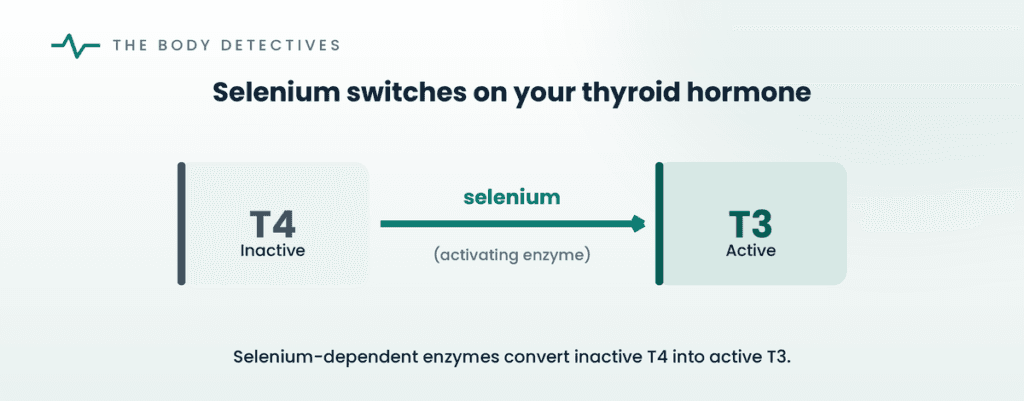
This is why selenium comes up so often in conversations about thyroid health. If you are looking into your own results, it helps to understand both your TSH level and your actual thyroid hormones, rather than focusing on a single number in isolation.
When to see a doctor
See a doctor if you have symptoms of a thyroid problem — such as unexplained tiredness, weight change, or feeling unusually hot or cold — rather than assuming it is a selenium issue. It is also wise to ask for advice before taking high-dose selenium supplements, especially if you already eat Brazil nuts regularly, and to get checked if you notice garlic breath, hair loss or nail changes after supplementing.
The bottom line
Selenium is a small mineral with a big job, sitting at the centre of your thyroid and your antioxidant defences. The catch is its narrow safe window: most people get everything they need from a normal diet, and the greater danger is usually too much rather than too little. Respect Brazil nuts, be cautious with supplements, and let food do the work.
This article is for general educational purposes only and is not a substitute for professional medical advice, diagnosis or treatment. Always speak to your own doctor about your health and before changing your diet or supplements. See our Medical Disclaimer for more information.