DHEA Levels: What This Hormone Does and Why It Falls
DHEA levels quietly peak in your twenties and then fall, decade by decade, for the rest of your life — a decline that has made DHEA one of the most hyped “anti-ageing” supplements on the shelf. But what is this hormone actually for? Made by your adrenal glands, DHEA is a raw material your body turns into other hormones, including testosterone and oestrogen. This guide explains what DHEA does, what high and low levels mean, why it drops with age, and whether the supplements live up to the claims.
What is DHEA?
DHEA (dehydroepiandrosterone) is a steroid hormone produced mainly by your adrenal glands, the small glands that sit on top of your kidneys. It’s the most abundant circulating steroid hormone in the body, yet it’s unusual in that it does relatively little on its own. Blood tests usually measure its stable storage form, DHEA-sulfate (DHEA-S), which gives a steadier reading than DHEA itself. For more, You and Your Hormones is a reliable source.
A building block for other hormones
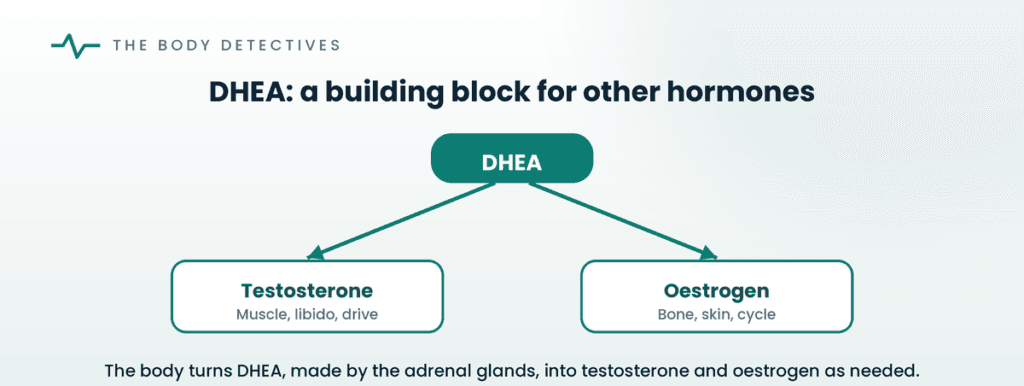
DHEA’s main job is to serve as a raw material:
Your tissues convert DHEA into the active sex hormones — testosterone and oestrogen — wherever and whenever they’re needed. Both men and women make and use DHEA, which is why it influences things like libido, mood, muscle, and bone in both sexes, just to differing degrees.
Why DHEA falls with age
Here’s the headline fact: DHEA-S peaks in your mid-twenties and then declines by roughly 10% a decade, so that by your seventies it may be only a fifth of its youthful level. This gradual fall — sometimes called “adrenopause” — is a normal part of ageing, not a disease. It’s also the reason DHEA is marketed as a fountain-of-youth supplement, on the logic that topping it back up might turn back the clock. As we’ll see, the reality is more complicated.
DHEA-S levels
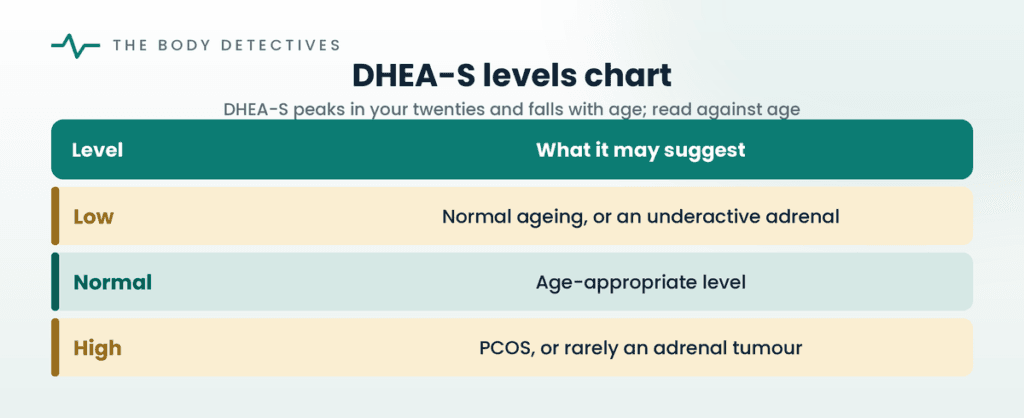
Because levels depend so heavily on your age and sex, results are interpreted against age-matched ranges rather than a single cut-off.
A result that’s high or low for your age can be a useful clue, but it’s the pattern — read together with your symptoms — that matters, not the number on its own.
What high or low DHEA means
A high DHEA-S is most often linked to polycystic ovary syndrome (PCOS) in women, where it can contribute to acne, excess hair growth, and irregular periods; rarely, a markedly high level points to an adrenal tumour. A low DHEA-S usually just reflects normal ageing, but it can also occur with adrenal insufficiency (an underactive adrenal gland), severe illness, or long-term steroid use. Doctors read it alongside other adrenal hormones such as cortisol.
Do DHEA supplements work?
This is where caution comes in. Despite bold claims about anti-ageing, energy, libido, and muscle, the evidence that DHEA supplements help otherwise healthy people is weak and inconsistent. Because DHEA is a hormone, supplements can cause real side effects — acne, hair changes, and unwanted hormonal effects — and they’re banned in competitive sport. There are specific medical situations where a doctor may prescribe it, such as adrenal insufficiency, but self-medicating to “reverse ageing” isn’t supported by good evidence. It’s wise to speak to a doctor before taking it.
When to see a doctor
Consider seeing your doctor if you have signs of a hormone imbalance — such as acne, excess hair growth, or irregular periods in women — or symptoms of an underactive adrenal gland like persistent fatigue, dizziness, and weight loss. A DHEA-S test is simple, but it’s most useful as part of a wider hormonal assessment rather than on its own.
The bottom line
DHEA is your body’s hormonal raw material — abundant in youth, naturally fading with age, and converted into testosterone and oestrogen behind the scenes. A high or low level can flag conditions worth investigating, but the age-related decline itself is normal and expected. And while DHEA supplements are heavily marketed, the evidence rarely matches the hype, so they’re best approached with healthy scepticism and medical advice.
This article is for general educational purposes only and is not a substitute for professional medical advice. Always consult your own doctor before taking supplements or about any hormone concern. See our Medical Disclaimer for more information.