Parathyroid Hormone (PTH): Your Body’s Calcium Thermostat
Parathyroid hormone is your body’s main thermostat for calcium — the dial that quietly keeps the level in your blood steady from one hour to the next. It is made by four tiny glands in your neck, behind the thyroid, and although you rarely hear about it, it guards one of the most tightly controlled numbers in the whole body. A blood test for parathyroid hormone, usually shortened to PTH, is how doctors check that this thermostat is doing its job. Here is what it does, why it is never read on its own, and what a high or low result really means.
What parathyroid hormone does
Calcium is not just for bones — your nerves, muscles and heart all rely on a steady level of it circulating in the blood. Parathyroid hormone is what stops that level from drifting. The moment blood calcium begins to fall, the four parathyroid glands release more PTH, which nudges it back up. The diagram below shows the three things it does at once.
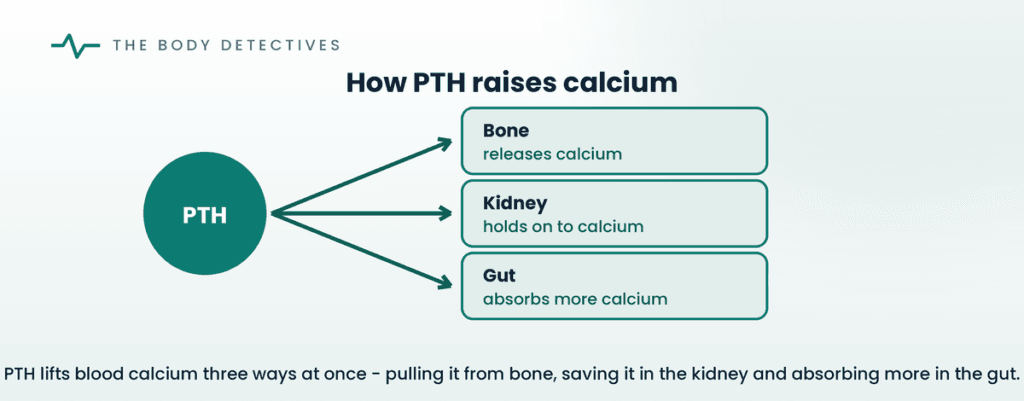
PTH frees a little calcium from your bones, tells your kidneys to hold on to calcium rather than lose it in the urine, and switches on vitamin D so your gut absorbs more from food. Once the level has recovered, the glands quieten down again — the same simple on-off feedback a thermostat uses to hold a room at one temperature.
Why parathyroid hormone is never read alone
Here is the part that catches people out: a PTH result means very little by itself. It only makes sense read side by side with the calcium measured at the same moment, because an identical PTH number can be reassuring or worrying depending on what calcium is doing. The chart below shows the main combinations.
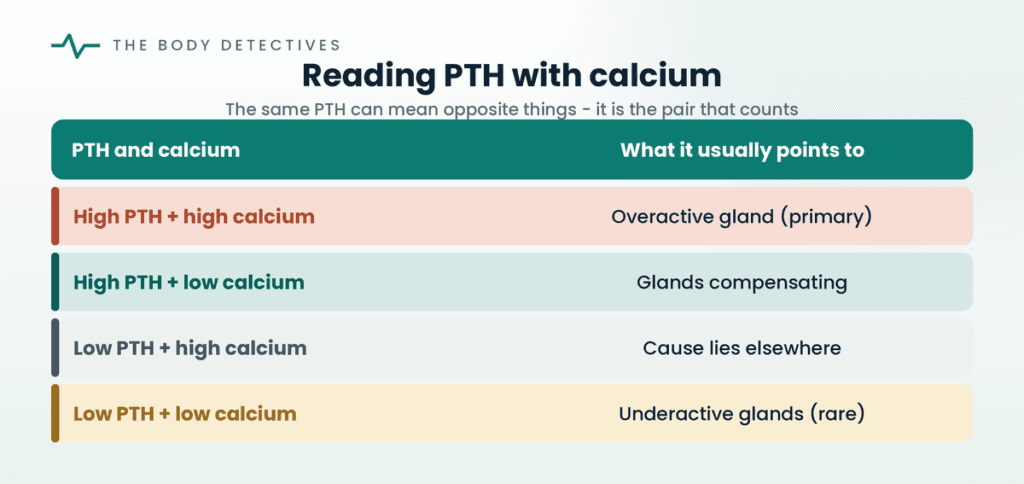
When PTH is high and calcium is high too, the glands are overactive and pushing calcium up when they should not — primary hyperparathyroidism, a common reason a raised calcium turns up by chance on a blood test. But when PTH is high while calcium is low or normal, the glands are usually doing exactly the right thing: working hard to defend calcium against another problem, most often a lack of vitamin D. Same high PTH, opposite meaning — which is why the pair always travels together.
When the glands over- or under-work
An overactive gland (hyperparathyroidism) keeps calcium too high, and over the years that can quietly thin the bones and encourage kidney stones, which is why a high calcium deserves attention even when you feel perfectly well. The reverse, an underactive gland (hypoparathyroidism), lets calcium drop too low; it is much rarer and tends to cause tingling, cramps or muscle spasms. Either way, it is the calcium-and-PTH pairing that usually reveals the problem long before symptoms would.
When to see a doctor
You would not normally request a PTH test yourself — it is ordered to explain an abnormal calcium, or to look into thinning bones or repeated kidney stones. Worth raising with your doctor are the clues that can accompany a disturbed calcium: unusual tiredness, recurrent kidney stones, nagging bone aches, or, when calcium runs low, persistent tingling around the lips and fingertips or muscle cramps. None of these is specific on its own, but alongside a calcium result they help your doctor know where to look.
The bottom line
Parathyroid hormone is the steady hand on your calcium dial — lifting the level when it dips and standing down when it recovers. The single most useful thing to remember is that PTH is never judged alone: it is the pairing of PTH with calcium that tells the real story. So if your result looks odd, find the calcium sitting beside it before drawing any conclusion, and let your doctor read the two together.
This article is for general educational purposes only and is not a substitute for professional medical advice, diagnosis or treatment. Always speak to your own doctor about your blood results and any symptoms that concern you. See our Medical Disclaimer for more information.