Aldosterone: The Hidden Hormone Behind Your Blood Pressure
Aldosterone is a hormone you have probably never thought about, yet it quietly helps set your blood pressure every single day. Made by the adrenal glands that sit on top of your kidneys, it is your body’s master controller of salt and water balance — and, through that, of the pressure inside your arteries. When it works smoothly you never notice it. When it runs too high or too low, it can drive blood pressure and potassium problems that are easy to miss. Here is what aldosterone does, what abnormal levels mean, and why it is one of the more important hormones to get right.
What aldosterone does
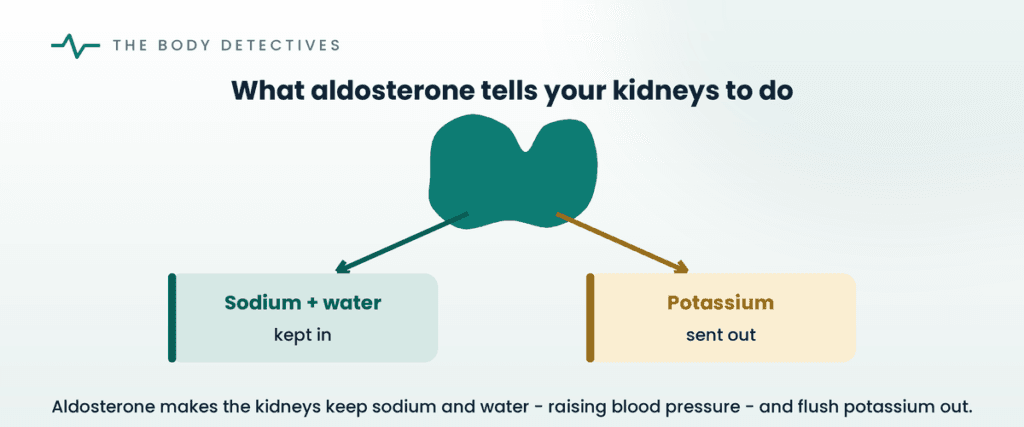
Aldosterone has one core instruction for your kidneys: hold on to sodium (salt), and let go of potassium. Where sodium goes, water follows — so retaining salt also retains water, which increases your blood volume and, with it, your blood pressure. At the same time, aldosterone pushes potassium out into your urine. The diagram below shows this balancing act.
Aldosterone does not act alone. It is the final step of a chain called the renin-angiotensin-aldosterone system, which springs into action whenever your blood pressure or the blood flow to your kidneys drops. The system raises aldosterone to claw back salt and water and restore your pressure — a clever safety mechanism that only becomes a problem when it gets stuck in the wrong gear.
What high or low aldosterone means
Because aldosterone sits at the crossroads of salt, water and potassium, its problems usually show up as a particular pattern in those very things. The chart below summarises it.
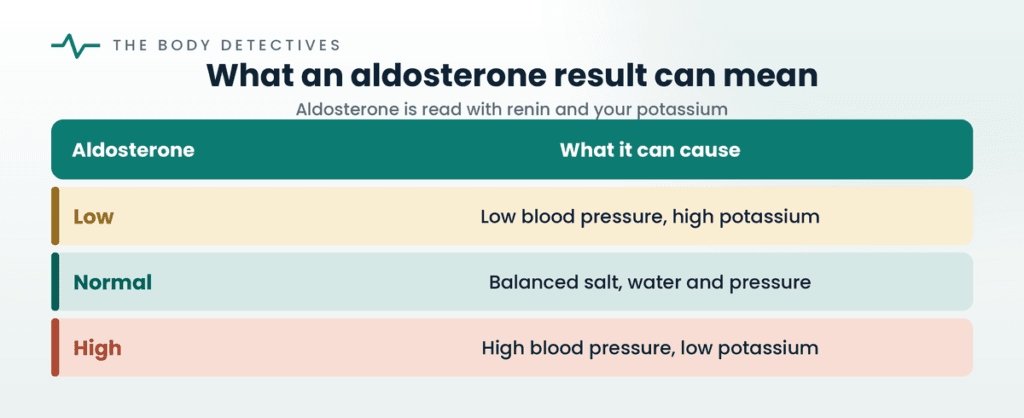
Too much aldosterone — often from a small, benign growth on an adrenal gland, a condition called primary hyperaldosteronism or Conn’s syndrome — drives up your blood pressure while pushing potassium down. It is an important and treatable cause of high blood pressure that resists the usual medications. Too little aldosterone, as in adrenal insufficiency, swings the other way: low blood pressure, fatigue, and a rising potassium level.
How aldosterone is tested
Aldosterone is rarely measured on its own. Because its job is so intertwined with the kidney, it is usually checked together with renin — the enzyme that switches it on — as a ratio, and read alongside your potassium and blood pressure. Timing, posture and even some common blood-pressure medicines can shift the result, which is why this test is interpreted carefully by a doctor rather than read off a single number.
When to see a doctor
You would not normally ask for an aldosterone test yourself; it is ordered when something does not add up — most often high blood pressure that is hard to control, or that appears at a young age, especially when paired with a low potassium level. See a doctor if your blood pressure stays high despite treatment, or if you have symptoms of low potassium such as muscle weakness, cramps or palpitations. These patterns are exactly what point a doctor towards checking this hormone.
The bottom line
Aldosterone is a small hormone with an outsized say in your blood pressure, working behind the scenes to balance salt, water and potassium. Most of the time it does its job invisibly. But when high blood pressure is stubborn — particularly alongside a low potassium — aldosterone is one of the hidden causes worth ruling out, because unlike many cases of raised pressure, this one often has a specific and treatable answer.
This article is for general educational purposes only and is not a substitute for professional medical advice, diagnosis or treatment. Always speak to your own doctor about your blood pressure, your test results and your health. See our Medical Disclaimer for more information.