Bilirubin Levels: What High Bilirubin Means
Your bilirubin levels are a window onto your liver and your red blood cells. Bilirubin is a yellow-orange pigment made when old red blood cells are broken down — the same pigment that gives a healing bruise its yellow tinge. Normally your liver clears it efficiently, but when bilirubin builds up, it can turn your skin and the whites of your eyes yellow, a sign called jaundice. This guide explains what’s normal, what a high level means, why it happens, and when to be concerned.
What is bilirubin?
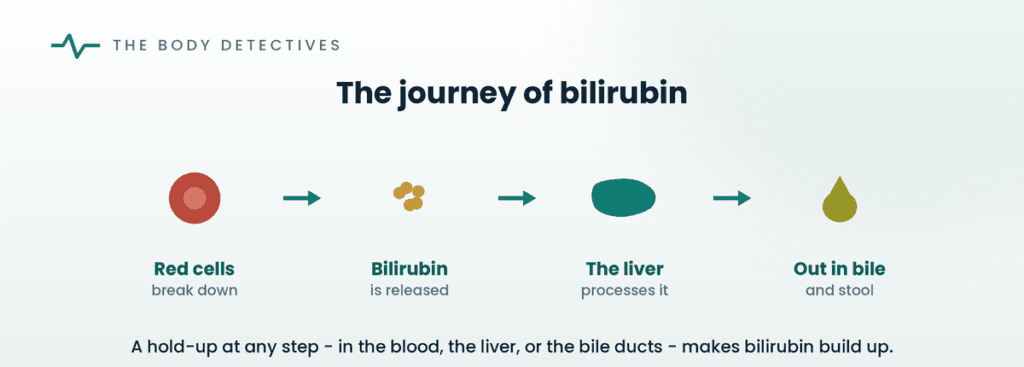
Bilirubin is a waste product from the constant recycling of your red blood cells. When old red cells are broken down, part of the haemoglobin inside them is converted into bilirubin, which travels in your blood to the liver. There, the liver processes it and sends it out in bile, which drains into your gut and eventually leaves the body — giving stool its brown colour along the way. It’s measured as part of your liver function tests, often alongside your liver enzymes. For more, Cleveland Clinic is a reliable source.
Normal bilirubin levels
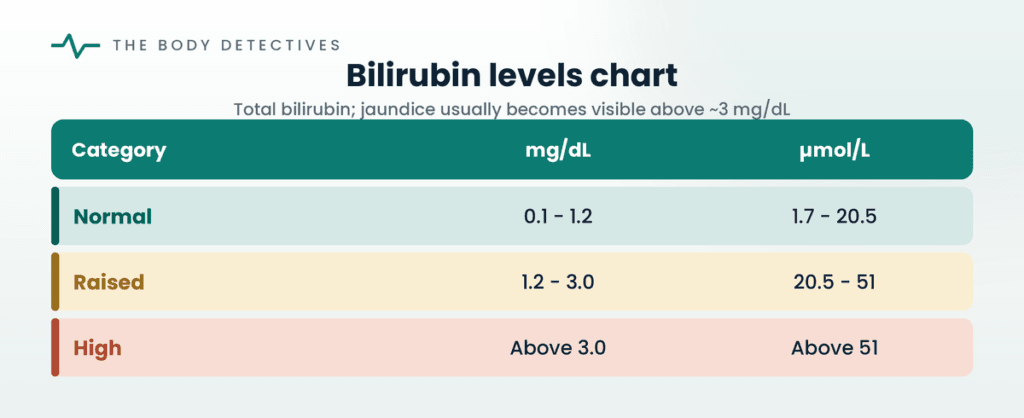
Bilirubin is reported as a total figure, sometimes split into “direct” (already processed by the liver) and “indirect” (not yet processed). It’s measured in mg/dL or µmol/L.
Jaundice — the visible yellowing — generally only appears once total bilirubin rises above about 3 mg/dL, so a mildly raised result often causes no outward signs at all.
Where bilirubin comes from
Because bilirubin passes through several steps — from red blood cells, through the liver, and out in bile — a hold-up at any stage can make it build up:
- Before the liver: too many red blood cells breaking down (haemolysis) floods the system with bilirubin.
- In the liver: conditions like hepatitis, cirrhosis, or the very common, harmless Gilbert’s syndrome slow down processing.
- After the liver: a blocked bile duct — most often from gallstones — backs bilirubin up into the blood.
What high bilirubin means
A raised bilirubin (hyperbilirubinaemia) is what causes jaundice, along with dark urine and sometimes pale stools or itching. The pattern matters: a high “indirect” bilirubin with normal liver enzymes often points to red-cell breakdown or Gilbert’s syndrome, while a high “direct” bilirubin suggests a liver or bile-duct problem. That’s why doctors rarely look at bilirubin alone — they read it with your liver enzymes and, if needed, a full blood count.
What is Gilbert’s syndrome?
Worth a special mention because it’s so common: Gilbert’s syndrome affects up to one in ten people and is completely harmless. It causes mildly raised bilirubin — and sometimes faint jaundice — especially when you’re fasting, unwell, stressed, or after exercise, because the liver processes bilirubin a little more slowly than average. It needs no treatment, and people who have it are otherwise perfectly healthy.
What about newborn jaundice?
High bilirubin is also very common in newborns, whose livers are still maturing and can’t clear it quickly. Most cases are mild and settle on their own, but because very high levels can be harmful to a baby’s brain, newborns are monitored closely and sometimes treated with light therapy, which helps break bilirubin down.
When to see a doctor
See your doctor promptly if you notice yellowing of your skin or eyes, dark urine, pale stools, or unexplained itching — especially alongside tummy pain, fever, or feeling generally unwell. In a newborn, any jaundice should be checked. A raised bilirubin is often harmless, but because it can also flag a liver or gallbladder problem, it’s always worth interpreting in context.
The bottom line
Bilirubin is the pigment left over when your body recycles red blood cells, and its level reflects how well your liver and bile system are clearing it. A mild rise is common and frequently harmless — Gilbert’s syndrome alone explains many cases — but a clearly high level, or one with jaundice, deserves a closer look. Read alongside your liver enzymes, it’s a valuable clue rather than a diagnosis on its own.
This article is for general educational purposes only and is not a substitute for professional medical advice. Always consult your own doctor about your blood test results. See our Medical Disclaimer for more information.