Thyroid Hormones (T3 & T4): What Your Levels Mean
Thyroid hormones set the pace of your entire metabolism — how fast you burn energy, how warm you feel, and how your heart, gut, and mood tick along. The two that matter most are T4 and T3, and they’re usually read together with TSH, the pituitary signal that controls them. This guide explains what T4 and T3 do, how to read them alongside TSH, and what high or low levels mean.
What are T4 and T3?
Your thyroid, a small butterfly-shaped gland in your neck, makes two main hormones: thyroxine (T4) and triiodothyronine (T3). T4 is the main hormone your thyroid releases — think of it as a stored, less-active form. Your tissues then convert most of it into T3, the active hormone that does the real work in your cells. Blood tests usually measure the “free” portion of each — the unbound fraction available for your body to use. For more, You and Your Hormones is a reliable source.
How TSH, T4, and T3 work together
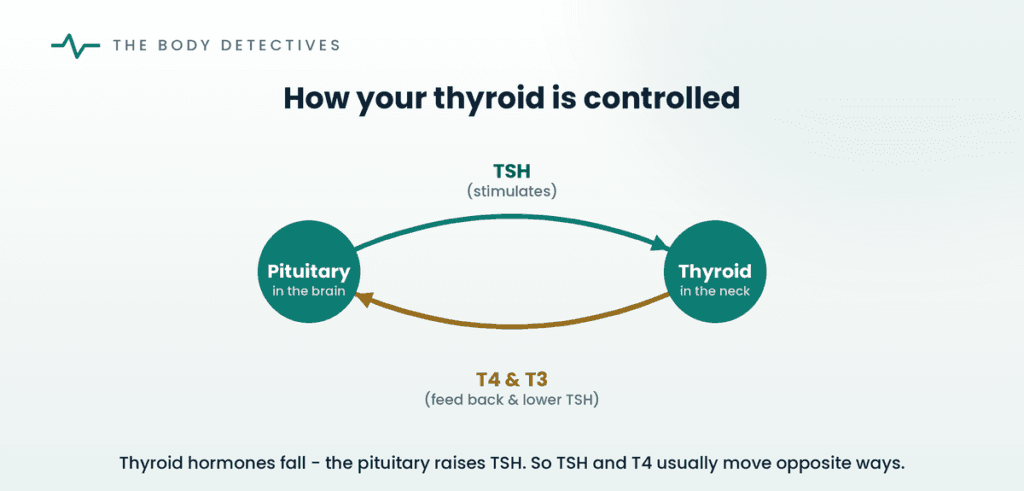
Your thyroid doesn’t act alone. Your pituitary gland releases TSH (thyroid-stimulating hormone) to tell the thyroid how much hormone to make. When thyroid hormone levels rise, they signal the pituitary to ease off TSH; when they fall, the pituitary pushes out more. This feedback loop is why TSH and thyroid hormones usually move in opposite directions — a key to reading your results.
Reading a thyroid panel
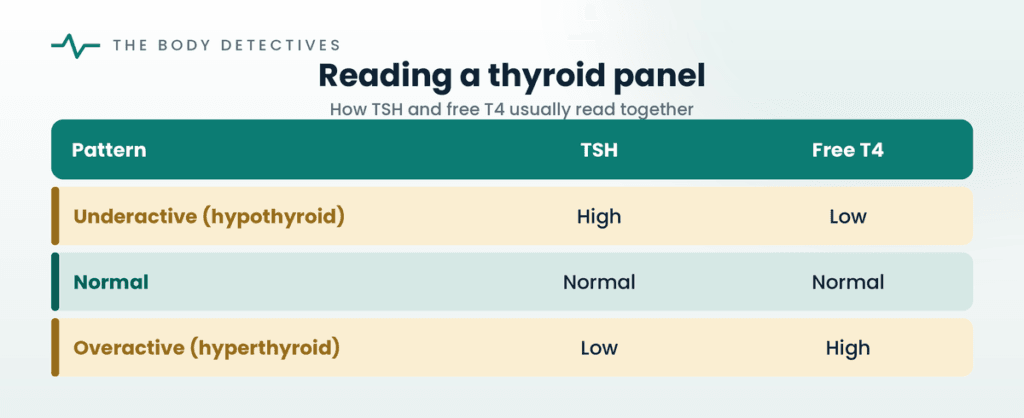
Because of that feedback loop, doctors interpret TSH and free T4 together rather than in isolation.
For reference, free T4 is usually around 12–22 pmol/L (about 0.9–1.7 ng/dL), free T3 around 3.1–6.8 pmol/L, and TSH around 0.4–4.0 mIU/L — though exact ranges vary by lab. Your TSH result is normally the first and most sensitive marker checked.
Signs of an underactive thyroid (hypothyroidism)
An underactive thyroid shows up as a high TSH with a low free T4 — the pituitary is shouting, but the thyroid isn’t keeping up. Because everything slows down, symptoms can include tiredness, weight gain, feeling cold, dry skin, constipation, low mood, and a slow heart rate. An underactive thyroid can also raise your cholesterol.
Signs of an overactive thyroid (hyperthyroidism)
An overactive thyroid is the mirror image: a low (suppressed) TSH with a high free T4 or T3. With everything speeding up, symptoms can include weight loss despite a good appetite, feeling hot, a racing or irregular heartbeat, anxiety, tremor, and trouble sleeping.
What about “subclinical” results?
Sometimes TSH is abnormal while free T4 stays normal — called subclinical hypo- or hyperthyroidism. This is common, doesn’t always need treatment, and is usually monitored over time, often with a repeat test and a check for thyroid antibodies.
When to see a doctor
See your doctor if you have ongoing symptoms that fit an under- or overactive thyroid, a strong family history, or an abnormal result on a routine test. Thyroid problems are common and very treatable once identified — and they’re diagnosed from a simple blood test read in full context.
The bottom line
T4 and T3 are your body’s metabolic accelerator, and they’re best understood next to TSH rather than alone. As a rule of thumb, a high TSH with low T4 points to an underactive thyroid, and a low TSH with high T4 to an overactive one. If your levels are off or symptoms persist, your doctor can confirm what’s happening and, where needed, treat it effectively.
This article is for general educational purposes only and is not a substitute for professional medical advice. Always consult your own doctor about thyroid tests or symptoms. See our Medical Disclaimer for more information.