
How Many Steps a Day Do You Really Need?
Ten thousand steps a day is one of the most repeated goals in health — the number your watch nudges you towards, the target that can feel like the price of a healthy day. So it may surprise you that it was never based on science at all. It began life as a marketing slogan, and the real research paints a far more encouraging picture: you bank most of the benefit long before you reach 10,000. Here is where the famous number came from, how many steps a day actually move the needle, and why every step genuinely counts.
Where “10,000 steps” actually came from
The 10,000 target is not a medical recommendation — it is a piece of 1960s marketing. In 1965, a Japanese company launched a pedometer called the Manpo-kei, which translates roughly as “10,000-steps meter”. The name was catchy, the round number stuck, and over the decades it quietly hardened into a global health commandment. It is a fine, motivating goal — but it was chosen by a marketing team, not a laboratory.
How many steps a day you really need
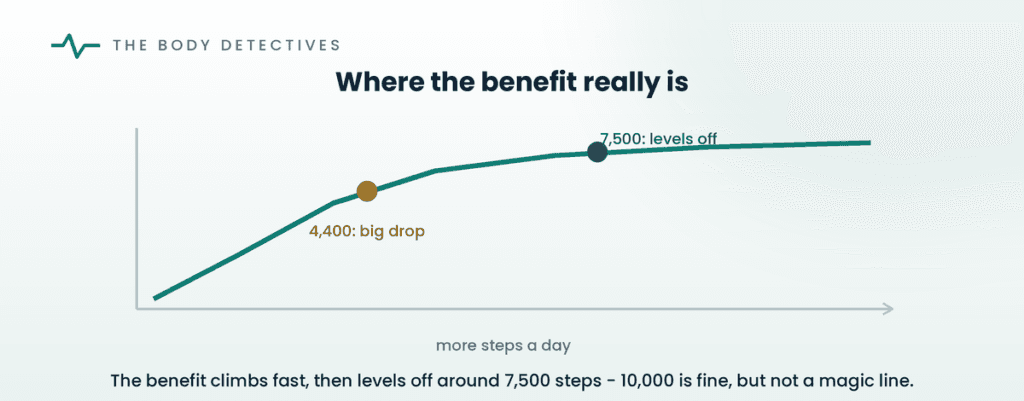
When researchers actually measured it, the picture turned out to be far kinder than the 10,000 rule suggests. In a large Harvard study of older women, those managing around 4,400 steps a day had a roughly 40% lower risk of dying over the follow-up than the most sedentary, who averaged about 2,700. The benefit kept climbing with more steps — but it levelled off at around 7,500. In other words, most of the reward was banked well before the magic 10,000. The chart below shows the pattern.
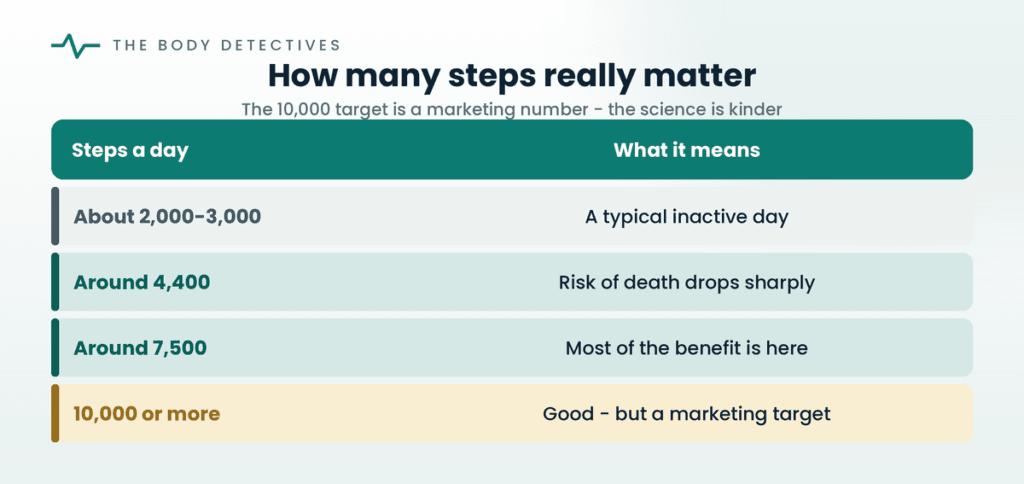
Two things are worth holding onto. First, the biggest gains come from simply moving from very little to a moderate amount — going from 3,000 to 6,000 steps helps far more than going from 8,000 to 11,000. Second, the exact sweet spot shifts with age: this study was in older women, and younger adults may benefit from a little more. The diagram below captures the shape of it — a steep climb that gradually flattens.
So what should you aim for?
Rather than fixating on 10,000, aim to move a bit more than you do now — that is the message the science genuinely supports. If you currently do 3,000 steps, 6,000 is a powerful goal. If you comfortably reach 8,000, you are already in excellent shape, and chasing 10,000 adds only a little. And because every step counts, it does not have to be a formal walk: pacing during calls, taking the stairs, parking further away, and a stroll after dinner all add up. The number on your watch is a useful nudge, not a pass-or-fail grade.
When to see a doctor
Walking is one of the safest activities there is, but a little common sense helps. If you have been very inactive, have a heart condition, or are much older, build up gradually rather than leaping to a big target overnight. And treat certain symptoms as a signal to stop and get checked rather than push through: chest pain or tightness, unusual breathlessness, dizziness, or an irregular, pounding heartbeat during activity all deserve medical attention. As a quiet bonus, regular walking gently lowers your blood pressure and resting heart rate over time — a real reward for simply moving more.
The bottom line
The 10,000-steps target is a motivating myth, not a medical rule. The science is more generous and more human: meaningful benefits begin at around 4,000 steps a day, most of the reward is in by roughly 7,500, and the single best thing you can do is move a little more than you did yesterday. So use the round number if it motivates you — but never treat falling short of it as failure. Every step genuinely counts.
This article is for general educational purposes only and is not a substitute for professional medical advice, diagnosis or treatment. If you have a heart condition or other health concerns, or you develop chest pain, breathlessness or dizziness during activity, speak to your own doctor before increasing your exercise. See our Medical Disclaimer for more information.