ESR Test: What a High Result Really Means
An ESR — short for erythrocyte sedimentation rate — is one of the oldest blood tests still in everyday use, and one of the most misunderstood. It does not diagnose any single disease. Instead, it is a simple, sensitive flag for inflammation somewhere in the body, measured in the most low-tech way imaginable: by watching how fast your red blood cells sink. Here is what an ESR actually tells you, what a high result can mean, and why doctors almost never read it on its own.
What an ESR test measures
The test is beautifully simple. A sample of your blood is placed in a tall, thin tube and left to stand for one hour. Red blood cells are heavier than the surrounding plasma, so they slowly sink, leaving a clear column of plasma at the top. The ESR is simply how far they fall in that hour, measured in millimetres. The diagram below shows the idea.
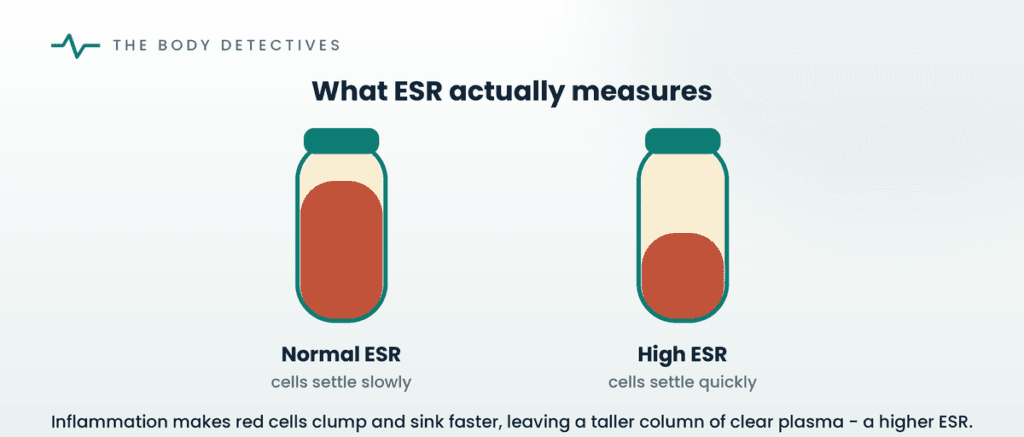
Here is the clever part. When there is inflammation, your blood carries more of certain sticky proteins that make red cells clump together. Clumped cells are heavier than single ones, so they sink faster — and your ESR rises. It is this clumping, rather than any change in the cells themselves, that the test is really detecting. That is why a raised ESR points to inflammation without ever saying what is causing it.
What a high ESR can mean
Because it is so non-specific, an ESR is best read in broad bands rather than as a precise number, and always alongside your symptoms and other tests. The chart below sums up the general picture.
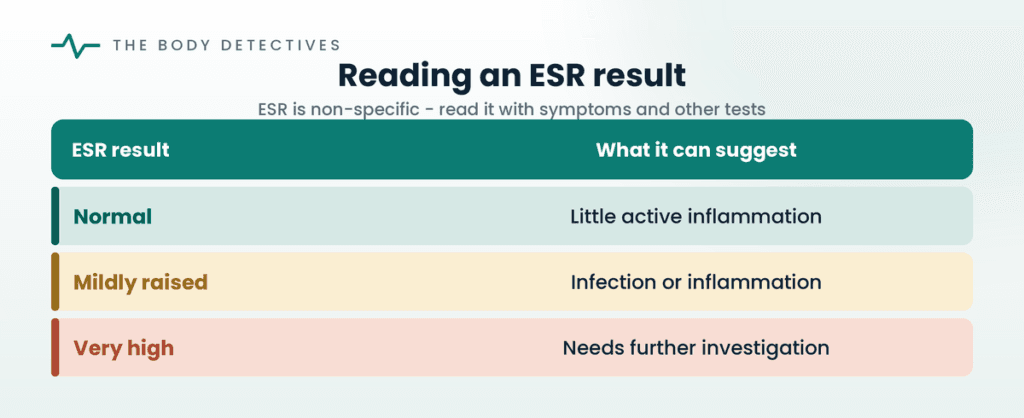
A mildly raised ESR is common and often harmless — it can simply reflect a recent infection, ageing, anaemia, pregnancy or even obesity. A very high ESR is more meaningful and prompts a proper search for a cause, which can range from infections and autoimmune conditions to, less often, certain cancers. A reading that climbs well into three figures is taken especially seriously and is rarely left unexplained. Normal values also drift upward with age and tend to run a little higher in women, which is why your own lab’s reference range matters.
ESR and CRP: the two inflammation markers
An ESR is often measured alongside its faster, more modern cousin, CRP. Both rise with inflammation, but they move at different speeds: CRP climbs and falls within days, while ESR changes more slowly over weeks. Used together, they give doctors a fuller sense of whether inflammation is new, settling, or quietly grumbling on — and your white blood cell count often completes the picture.
When to see a doctor
An ESR is almost always ordered by a doctor while investigating specific symptoms, so the result usually comes with medical advice attached. See a doctor promptly if a raised ESR comes with warning signs such as persistent fever, unexplained weight loss, night sweats, severe headaches, or new joint pain and stiffness — particularly in older adults, where these can point to conditions that need quick treatment. On its own, though, a mildly raised ESR is rarely a cause for alarm.
The bottom line
An ESR is a humble but useful test: a one-hour glimpse at whether inflammation is brewing somewhere in your body. It cannot tell you where or why on its own, which is exactly why it is read in context — with your symptoms, your history, and partner tests like CRP. Treat a single raised number as a question to explore with your doctor, not an answer in itself.
This article is for general educational purposes only and is not a substitute for professional medical advice, diagnosis or treatment. Always speak to your own doctor about your test results and your health. See our Medical Disclaimer for more information.