Smartwatch AFib Alert: What It Means and What to Do
A smartwatch AFib alert can be genuinely unnerving: one glance at your wrist, and your watch is suddenly telling you that your heart rhythm may not be normal. Before you panic — or dismiss it — here is the balanced truth from a doctor’s point of view. That alert is worth taking seriously, because the rhythm it screens for can be dangerous. But it is a screening tool, not a diagnosis. Think of it as a smart smoke alarm: it is telling you to look closer, not that the house is on fire.
What a smartwatch AFib alert actually means
Modern smartwatches quietly watch your pulse in the background, and when they spot a beat that looks irregular, they can prompt you to take a 30-second single-lead ECG on the watch itself. What they are screening for is atrial fibrillation — AFib for short — a common rhythm problem in which the heart’s upper chambers beat in a fast, chaotic way instead of a steady rhythm. Your watch already tracks simpler things like your resting heart rate and heart rate variability; an AFib alert is a step up — a flag that the pattern of your beats, not just their speed, looked abnormal.
Why AFib is worth taking seriously
AFib matters because it is both common and sneaky. It is often silent — many people have it without feeling a thing — yet it raises the risk of stroke roughly fivefold, because blood can pool in the fibrillating chambers, form a clot, and travel to the brain. That is exactly why catching it early is so valuable: once AFib is confirmed, doctors can treat it and, crucially, use blood-thinning medication to prevent strokes before they happen. So an alert from your wrist is not something to wave away — for some people, it is the first warning of a genuinely treatable, stroke-preventing diagnosis.
But your watch is a screening tool, not a diagnosis
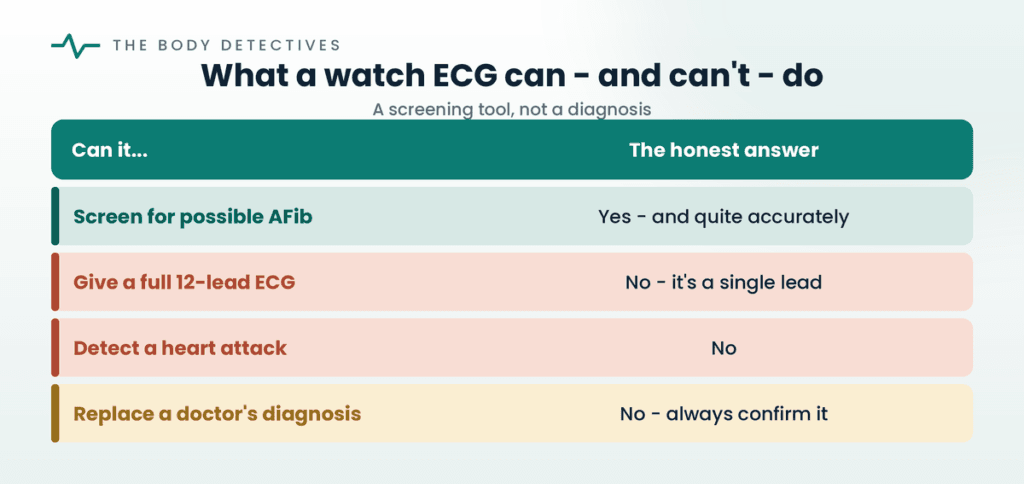
Here is the other half of the truth. When a watch ECG gives a clear result, it is impressively good at spotting AFib — but the readings are not perfect. In one review of popular devices, about a quarter of ECG recordings came back “inconclusive”, and false positives do happen: the watch can flag AFib that is not really there, which is a recipe for needless anxiety. A single-lead watch ECG is also a simplified snapshot, not the full medical-grade ECG a clinic records — it cannot detect a heart attack or most other cardiac problems. In short: your watch can raise the question, but only a doctor can answer it.
What to do if your watch flags AFib
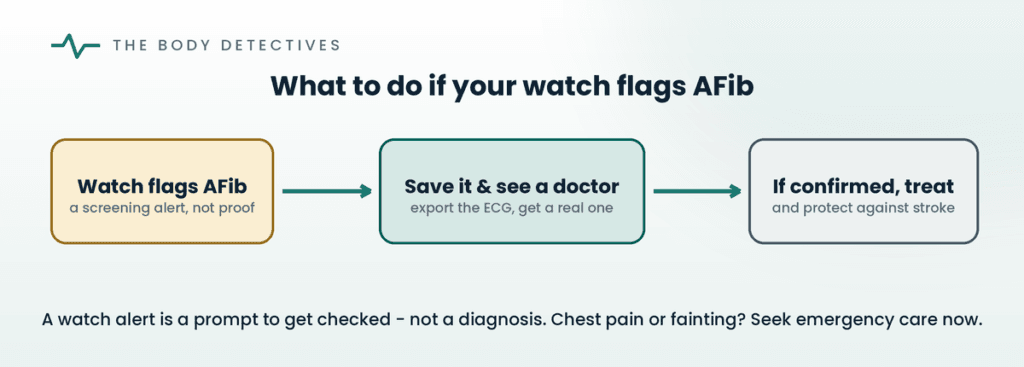
Do two things, and avoid two things. Do save the reading — most watches let you export the ECG as a PDF — and book an appointment with your doctor, who can confirm the rhythm with a proper ECG or a longer heart monitor. Don’t panic over a single alert, and don’t ignore repeated ones. The important exception is red-flag symptoms: if the alert comes with chest pain, fainting or near-fainting, severe breathlessness, or you simply feel very unwell with a racing, irregular pulse, treat it as an emergency and seek urgent care straight away rather than waiting for an appointment.
Should you rely on your watch?
These features are a real advance, and they have caught silent AFib early in many people who would otherwise never have known. They are most useful if you are older or have risk factors for AFib. In young, healthy, low-risk people, though, the balance shifts: alerts are more likely to be false alarms, and the anxiety can outweigh the benefit. The sensible way to see it is this — a smartwatch is a helpful extra sensor, not a replacement for medical care.
The bottom line
A smartwatch AFib alert is a smart smoke alarm: worth taking seriously, not worth panicking over. It can flag a hidden, stroke-raising rhythm early — which is genuinely valuable — but it cannot make the diagnosis. If your watch flags AFib, save the reading, stay calm, and get it confirmed by a doctor. Used that way, the thing on your wrist becomes a useful early-warning system, not a source of dread.
This article is for general educational purposes only and is not a substitute for professional medical advice, diagnosis or treatment. A smartwatch cannot diagnose a heart condition. If your device flags an irregular rhythm, discuss it with a qualified doctor; and if you have chest pain, fainting, or severe breathlessness, seek emergency care immediately. See our Medical Disclaimer for more information.