

Omega-3 Index: Is Your Fish Oil Actually Working?
The Omega-3 Index is one of the most useful health tests you have probably never heard of. Millions of people swallow a fish-oil capsule every morning and simply hope it is doing something — with no way of knowing whether it actually is. This single blood test answers that question directly: it measures how much omega-3 has genuinely made it into your body, and tells you whether you are in the healthy range or falling short. Here is what it measures, what a good result looks like, and how to move your number in the right direction.
What the Omega-3 Index measures
The Omega-3 Index measures the amount of the two most important marine omega-3 fats — EPA and DHA — sitting in the membranes of your red blood cells, expressed as a percentage of all the fatty acids there. Because red blood cells live for around four months, the index reflects your long-term omega-3 status, not just what you ate yesterday — which makes it a stable, reliable snapshot rather than a moving target. In plain terms, it shows how well-stocked your body really is, not how many capsules you have bought.
What’s a good Omega-3 Index?
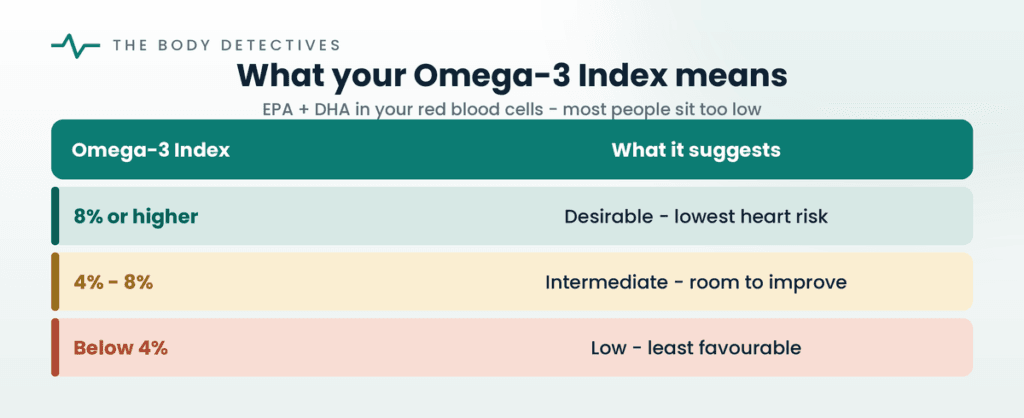
The researchers who developed the test grouped the results into simple bands. An index of 8% or higher is considered desirable and is linked in studies to the lowest risk of heart problems, while a level below 4% is the least favourable and tied to higher risk; the 4–8% zone sits in between. The sobering part is where most people land: the average Western adult scores only around 4–5%, firmly in the low range. In other words, most of us are far less topped up than we assume — which is exactly why measuring beats guessing.
Why it matters
Omega-3s are not just “heart oils”. EPA and DHA are built into the membranes of cells throughout your body, they help calm inflammation, and DHA is a major structural component of the brain and the retina. A higher Omega-3 Index has been associated with a lower risk of dying from heart disease, and there is growing research interest in its links to brain ageing and mood. None of this makes omega-3 a miracle — but a very low index is a real, fixable gap, and this test is how you find it. It complements the usual heart markers like your cholesterol and CRP, filling in a piece those tests miss.
How to raise your Omega-3 Index
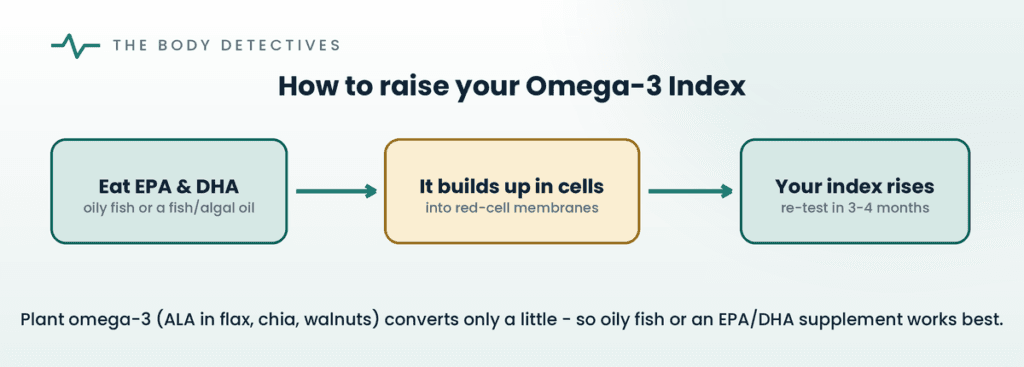
The most reliable way to lift your index is to give your body more EPA and DHA directly. Oily fish are the richest source — salmon, mackerel, sardines, herring and anchovies — ideally two or more portions a week. If you rarely eat fish, a good-quality fish-oil or (for vegans) algal-oil supplement providing EPA and DHA does the job. One common trap is worth flagging: the plant omega-3 in flaxseed, chia and walnuts (called ALA) is healthy, but your body converts only a tiny fraction of it into EPA and DHA — so flax alone rarely moves the index much. Whatever route you choose, the beauty of the test is that you can re-check in a few months and see whether it actually worked.
When to see a doctor
The Omega-3 Index is usually a self-requested test rather than a routine one, so ask your doctor or a reputable lab if you would like it done. Speak to your doctor before starting high-dose fish oil if you take blood thinners or have a bleeding disorder, because large doses can affect clotting. It is also worth a conversation if you are pregnant — DHA matters in pregnancy — or if you are managing heart disease, so that any supplement fits sensibly with the rest of your care rather than being taken in isolation.
The bottom line
The Omega-3 Index turns a daily guess into a simple number. Rather than hoping your fish-oil habit is working, you can measure whether your body is genuinely topped up — aiming for 8% or more — and adjust with oily fish or a proper EPA/DHA supplement if you fall short. It is a small test that quietly answers a very common question: is any of this actually doing anything?
This article is for general educational purposes only and is not a substitute for professional medical advice, diagnosis or treatment. Reference ranges vary between laboratories, and supplements can interact with medicines such as blood thinners. Talk to a qualified doctor before making changes, especially if you are pregnant, have a bleeding disorder, or manage a heart condition. See our Medical Disclaimer for more information.