Platelet Count: What Normal, High, and Low Mean
Your platelet count is one of the quiet workhorses of a routine blood test, yet it reflects something vital: your blood’s ability to stop bleeding. Platelets are tiny cell fragments that rush to any injury and clump together to seal it. Too few, and you may bruise or bleed easily; too many, and your blood can clot when it shouldn’t. This guide explains what a normal platelet count is, what high and low results mean, and when they matter.
What are platelets?
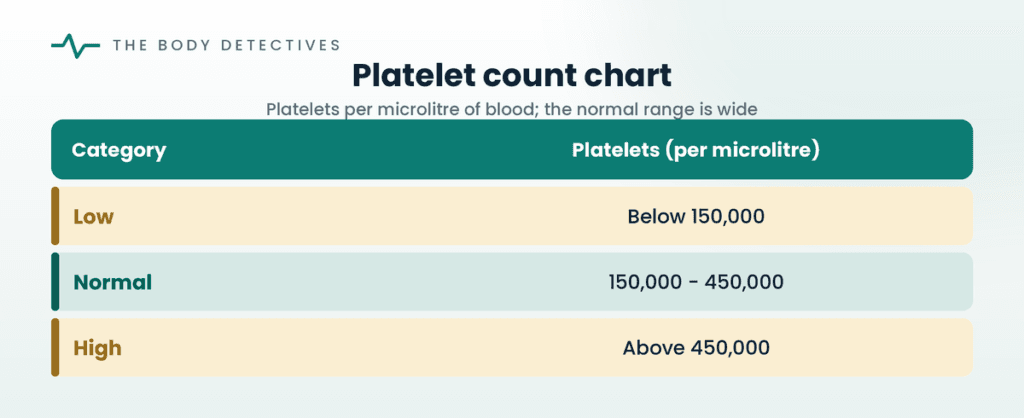
Platelets, also called thrombocytes, are the smallest of your blood cells — really cell fragments made in your bone marrow. They circulate quietly until a blood vessel is damaged, then spring into action: they travel to the site, change shape to grow sticky tentacles, and clump together to form a plug. They also release signals that trigger the clotting cascade, which builds a tough fibrin mesh to seal the wound. Without enough working platelets, even small injuries could bleed for too long.
How a platelet count is measured
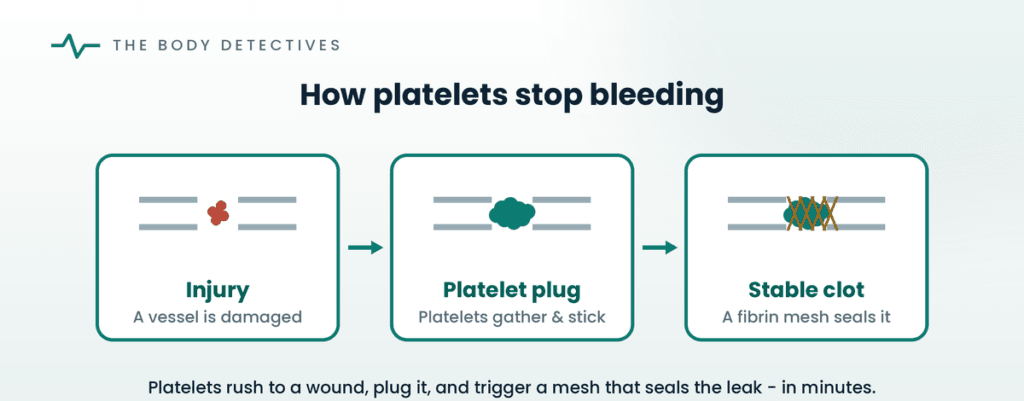
Platelets are counted as part of a full blood count (FBC), also called a complete blood count, and reported as the number per microlitre of blood. For more detail, Cleveland Clinic is a reliable source.
That’s a wide healthy range — roughly 150 to 450 × 10⁹/L — with plenty of room for normal variation between people. Counts can also drift down slightly with age while still being perfectly healthy, which is why doctors look at the trend as well as the single number.
How platelets stop bleeding
The whole process happens in minutes: an injury exposes the vessel wall, platelets gather and stick to form a temporary plug, and a fibrin mesh then reinforces it into a stable clot. It’s a remarkably fast, well-orchestrated system — and the reason a healthy platelet count matters so much for everyday cuts and scrapes.
What a low platelet count means (thrombocytopenia)
A low count (thrombocytopenia) means fewer platelets than normal, which can make you bruise easily, bleed for longer from cuts, or notice nosebleeds, bleeding gums, or tiny red spots on the skin (petechiae). Causes include the bone marrow making fewer platelets, the body breaking them down (as in immune conditions or with certain medicines), an enlarged spleen storing too many, viral infections, liver disease, and deficiencies of vitamin B12 or folate. Bleeding risk only rises significantly when counts fall well below the normal range.
What a high platelet count means (thrombocytosis)
A high count (thrombocytosis) is most often reactive — a temporary rise driven by something else, such as infection, inflammation, recent surgery, or iron deficiency. Less commonly, it’s caused by a bone-marrow condition that overproduces platelets. Many people have no symptoms at all, but very high counts can raise the risk of abnormal clots, so the cause is usually investigated and the count rechecked over time.
When to see a doctor
A platelet result outside the normal range is common and often harmless, but it should be reviewed by your doctor, who will look at the rest of your blood count and may simply repeat the test. Seek prompt advice for unexplained or heavy bruising and bleeding, lots of tiny red skin spots, or — with a high count — symptoms of a clot such as a swollen, painful leg or sudden breathlessness.
The bottom line
Your platelet count is a window onto how well your blood can clot. A wide normal range means small fluctuations are usually nothing to worry about, and many abnormal results are temporary or reactive. Still, because both very low and very high counts carry real risks, any result outside the range is worth a conversation with your doctor — read, as always, alongside the rest of your blood count.
This article is for general educational purposes only and is not a substitute for professional medical advice. Always consult your own doctor about your blood test results. See our Medical Disclaimer for more information.