Respiratory Rate: The Most Overlooked Vital Sign
Respiratory rate — the number of breaths you take in a minute — is the quietest of the four main vital signs, and arguably the most underrated. While heart rate and blood pressure get all the attention, the rate at which you breathe is often the very first thing to change when something is wrong, sometimes long before any other number stirs. It is simple to measure and easy to overlook, which is exactly why those who pay attention to it can spot trouble early. Here is what a normal respiratory rate looks like, what makes it rise, and when a change is worth taking seriously.
What a normal respiratory rate is
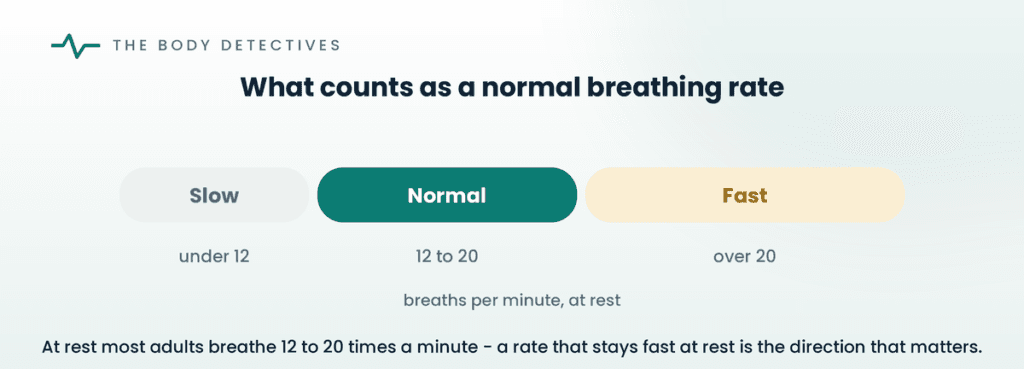
At rest, most healthy adults breathe somewhere between 12 and 20 times a minute. You rarely think about it, because your breathing is run automatically by your nervous system, quietly adjusting to keep oxygen coming in and carbon dioxide going out. You can take over consciously for a while — speeding up, or holding your breath — but the moment you stop paying attention, your body takes the controls back. The bar below shows the usual range.
Why doctors call it the overlooked vital sign
Here is what makes respiratory rate so valuable: it is frequently the earliest sign that something is wrong. When the body is under strain — fighting an infection, short of oxygen, or sliding towards serious illness — breathing tends to speed up before the heart rate climbs or the blood pressure drops. Yet it is also the vital sign most often skipped, because counting breaths takes a full minute and no machine beeps it out for you. Read alongside your resting heart rate and blood oxygen level, a steadily rising rate is a genuine early warning. The chart below shows the common reasons it climbs.
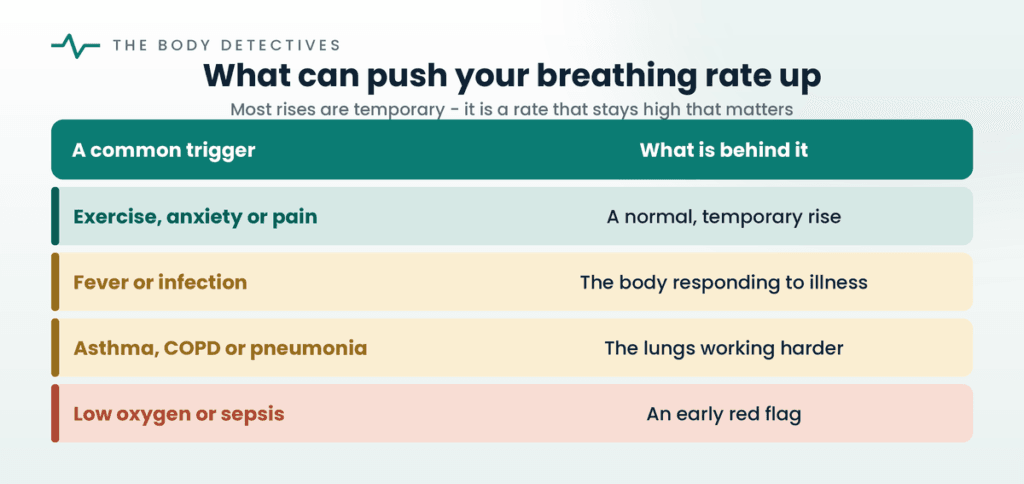
Most of the time a faster rate has an innocent explanation — exercise, a fever, anxiety or pain will all push it up briefly and settle as the cause passes. What matters is a rate that stays high while you are resting, or one that climbs as you start to feel unwell or breathless. That pattern is the body asking for help, and it is the reason a single minute spent counting breaths can be so revealing.
When to see a doctor
To check your own, count your breaths for a full minute while sitting quietly — one rise and fall of the chest is a single breath. See a doctor if your resting rate is persistently above about 20 to 25 a minute, and seek urgent care if fast breathing comes with chest pain, bluish lips, severe breathlessness, or a feeling that you cannot get enough air. At the other end, an unusually slow rate — under about 12 — together with drowsiness or confusion also needs emergency attention, as it can mean breathing is being suppressed. In a child, breathing that is fast, laboured, or accompanied by the skin tugging in around the ribs always warrants prompt review.
The bottom line
Respiratory rate is the unsung member of the vital-sign family: easy to measure, easy to ignore, and quietly one of the most honest signals your body gives. Most rises are temporary and harmless, but a rate that stays high at rest — or climbs as you feel worse — deserves attention precisely because it so often speaks first. Next time you check your pulse, spend one more minute simply counting breaths; it may tell you more than you expect.
This article is for general educational purposes only and is not a substitute for professional medical advice, diagnosis or treatment. If you or someone else is struggling to breathe, breathing very fast or very slowly, or turning blue around the lips, treat it as an emergency and seek immediate medical help. See our Medical Disclaimer for more information.