Lipoprotein(a): The Inherited Heart Risk You’ve Never Tested
Lipoprotein(a) — often written Lp(a) and said out loud as “L-P-little-a” — may be the most important heart-health number you have never had measured. You can eat well, exercise, never smoke, and get a cholesterol result your doctor calls “normal” — and still carry a hidden, inherited risk to your heart. The reason is simple and a little unfair: the standard cholesterol test does not measure Lp(a) at all. Here is what it is, why it slips through the net, and what a high result really means.
What lipoprotein(a) is
Lp(a) is a particle in your blood closely related to LDL — the so-called “bad” cholesterol — but with an extra sticky protein wrapped around it. Like LDL, it can burrow into artery walls and help build the plaques that narrow blood vessels. But Lp(a) has two extra tricks: it encourages blood to clot, and it stirs up inflammation inside the vessel wall. That combination is why a high level pushes up the risk of heart attack, stroke, and a stiffening of the heart’s aortic valve — quietly, and often decades in advance.
Why your cholesterol test misses it
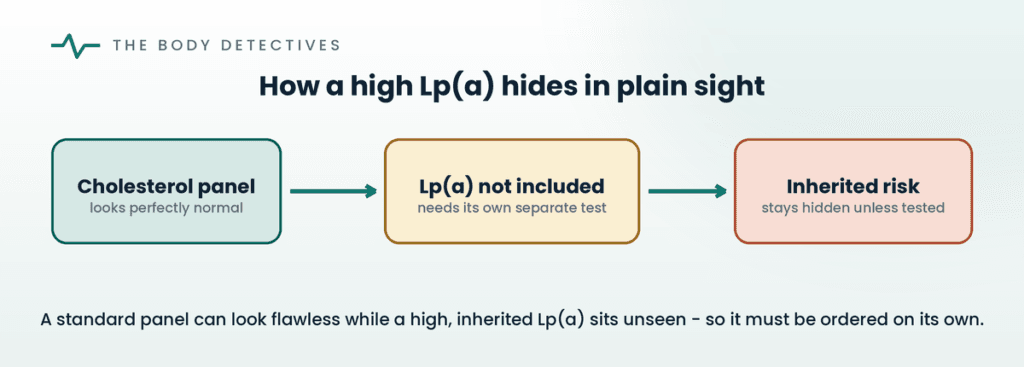
Here is the catch that surprises almost everyone: a routine cholesterol panel — total cholesterol, LDL, HDL and triglycerides — does not include Lp(a). It has to be requested as a separate blood test, and most people never are. That means a completely reassuring cholesterol result can sit on top of a high Lp(a) that no one has ever looked for. If heart disease runs in your family despite “good numbers”, this hidden particle is one of the prime suspects.
It is written in your genes
Unlike LDL, which rises and falls with your diet, weight and lifestyle, Lp(a) is set almost entirely by the genes you inherit from your parents. The level you had as a child is, more or less, the level you will carry for life — and healthy eating, exercise and weight loss barely move it. That sounds like bad news, but it hides a real upside: because the number is so stable, you usually only need to measure it once in your lifetime. One test, and you know where you stand for good.
What a high result means — and what you can do
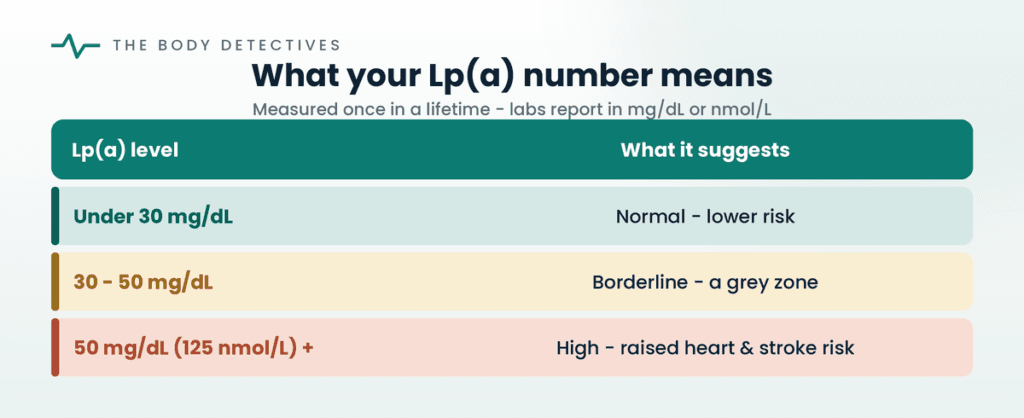
Broadly, an Lp(a) under about 30 mg/dL is considered normal, while a level of 50 mg/dL — roughly 125 nmol/L — or above is generally treated as high and linked to greater cardiovascular risk, according to the American Heart Association (labs vary, and report in either unit). Frustratingly, ordinary statins do not lower Lp(a) much. But a high number is not a sentence — it is a call to action. Because you cannot change the Lp(a) itself, the winning move is to drive down every other risk you can: LDL cholesterol, blood pressure, smoking, blood sugar and weight. Targeted drugs that lower Lp(a) directly are also now in advanced trials.
When to see a doctor
Ask your doctor whether a one-off Lp(a) test is worthwhile — especially if heart disease or stroke runs in your family, particularly at a young age; if you have been told you have familial high cholesterol; or if you have had a heart attack or stroke yourself despite otherwise good numbers. And treat the usual red flags as urgent whatever your Lp(a): sudden chest pain, breathlessness, or the face-arm-speech signs of a stroke need emergency help immediately, not an appointment.
The bottom line
Lipoprotein(a) is the inherited heart risk hiding behind a normal cholesterol result. It is common, it is missed by the standard panel, and it is fixed largely by your genes — but none of that makes you powerless. A single, inexpensive test can reveal it; and once you know, you and your doctor can attack every other risk factor with real purpose. You cannot change the number you were born with — but you can change almost everything around it.
This article is for general educational purposes only and is not a substitute for professional medical advice, diagnosis or treatment. Reference ranges and units vary between laboratories, and decisions about testing and treatment should be made with a qualified doctor. If you have chest pain, sudden breathlessness, or signs of a stroke, seek emergency care immediately. See our Medical Disclaimer for more information.