Prolactin: The Milk Hormone Your Brain Keeps in Check
Prolactin is best known as the hormone that lets a new mother produce milk — its very name means “for milk”. But it is a curious hormone in one important way: unlike most, which the body actively switches on, prolactin is one the brain spends most of its time holding down. That single quirk explains a great deal about why a prolactin level can come back high, and why a raised result is usually far less alarming than it first sounds. Here is what prolactin does, why it rises, and when a high level is worth investigating.
What prolactin does
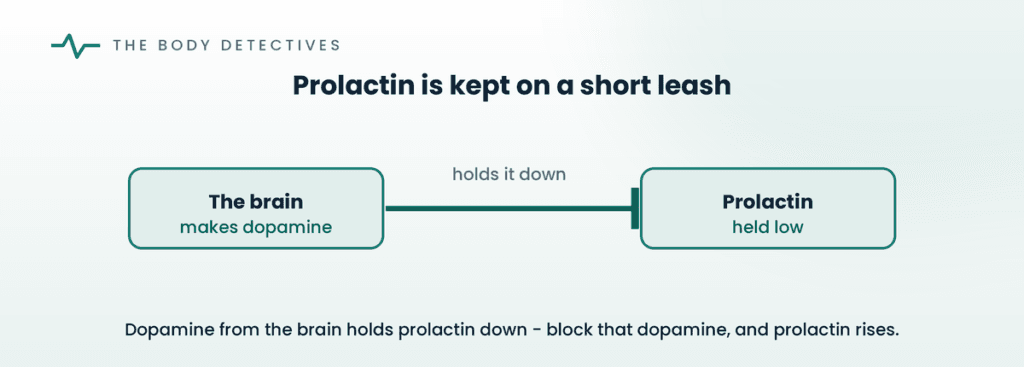
Prolactin is made by the pituitary, the small master gland beneath your brain, and its headline job is lactation: during and after pregnancy it drives the breast to develop and produce milk. What sets it apart is how it is controlled. Most hormones are released on demand, but prolactin is kept on a permanent leash by dopamine, a chemical messenger from the brain that continually restrains it — the more dopamine, the less prolactin. The diagram below shows that unusual set-up.
Why prolactin can be high
Because dopamine holds prolactin down, a high level often means that brake has simply been eased off — which is why the causes are so often ordinary. Pregnancy and breastfeeding raise it enormously and completely normally; so, briefly, can stress, exercise, a recent meal or even nipple stimulation, which is why a single high reading is usually repeated before anyone reads much into it. The chart below shows the causes worth knowing.
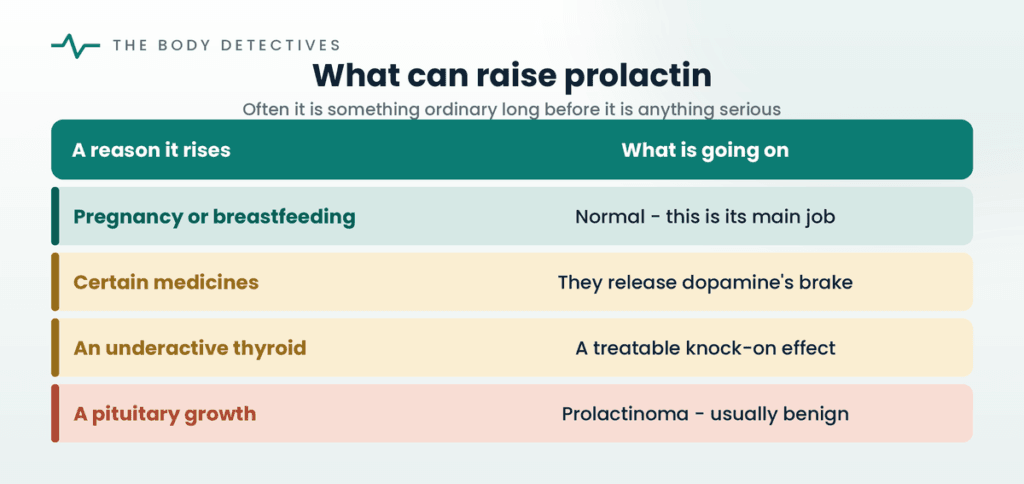
Two of the most common lasting causes are entirely treatable. Many medicines — particularly some for nausea, and several used in mental health — work by blocking dopamine, and in doing so they let prolactin climb. An underactive thyroid can nudge it up too. Less commonly, a small benign growth on the pituitary called a prolactinoma makes prolactin of its own accord; it is rarely dangerous, but it is the cause doctors most want to catch, because it may need treating. Reassuringly, even a prolactinoma can usually be controlled with tablets that mimic dopamine — the very brake it had been ignoring — and it rarely needs surgery.
When to see a doctor
The symptoms that point to a genuinely high prolactin come from two directions: the milk-making itself, and the way excess prolactin quietly turns down your sex hormones. Worth checking with a doctor are milky nipple discharge when you are not breastfeeding, periods that become irregular or stop, a dip in sex drive or fertility, and, in men, difficulty with erections or a fall in testosterone. Persistent headaches or changes in your vision alongside these are a more urgent flag, as a larger pituitary growth can press on nearby nerves. None of this means the worst — but it does mean the level deserves a proper look.
The bottom line
Prolactin is the milk hormone the brain keeps firmly in check, and that is the key to reading it. A high result is common and frequently harmless — driven by pregnancy, a passing stress, a medication or an underactive thyroid far more often than by anything serious. The job of a doctor is simply to work through that list in order, confirm the level on a repeat test, and treat the cause if one is found. More often than not, the story turns out to be a reassuring one.
This article is for general educational purposes only and is not a substitute for professional medical advice, diagnosis or treatment. If you have milky discharge, changes to your periods, or persistent headaches or vision changes, speak to your own doctor, who can arrange the right tests. See our Medical Disclaimer for more information.