Sodium: The Blood Test That’s Really About Water
Sodium is the electrolyte everyone links with salt — and that link causes one of the most common misunderstandings in all of blood testing. When your sodium level comes back high or low, most people assume it reflects how much salt they have been eating. It almost never does. Your blood sodium is really a measure of the balance between sodium and water in your body — in other words, it is mostly a reading of your hydration. Grasp that one idea, and a high or low sodium suddenly makes sense. Here is what sodium does, what a high or low level really means, and when it matters.
What your sodium level really measures
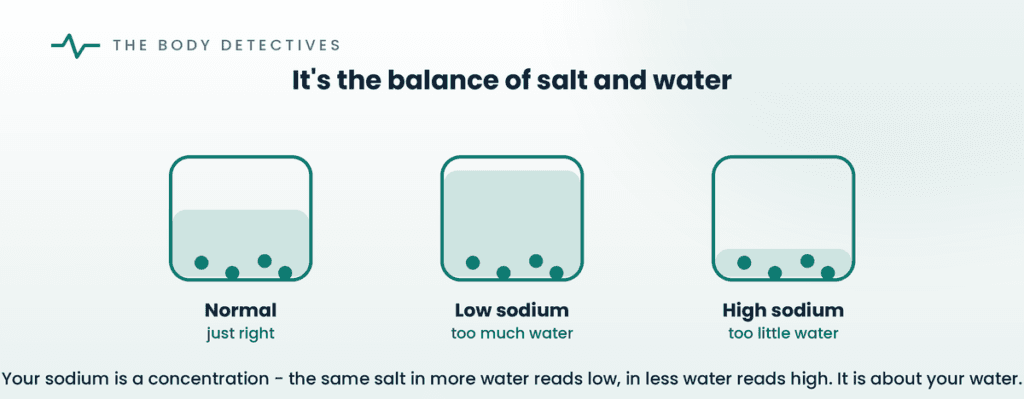
Sodium is the main electrolyte in the fluid outside your cells, where it governs how much water your body holds and helps your nerves and muscles fire. Your body guards it fiercely, keeping it within a narrow band using thirst, your kidneys and a hormone called ADH to fine-tune the water side of the equation. And that is the crucial point: the number on your report is a concentration — sodium divided by water. Add too much water and the concentration falls; lose water and it climbs, even though the amount of salt has barely changed. The diagram below shows the idea.
Why sodium goes low or high
Because it is a concentration, a low sodium (hyponatraemia) — one of the most common findings on any blood test — usually means too much water rather than too little salt. That water can come from simply drinking more than the kidneys can clear, from a hormone problem that makes the body hold on to water, or from heart, liver or kidney conditions that let fluid build up. A high sodium is the mirror image: nearly always dehydration, from not drinking enough or losing fluid through illness. The chart below sorts out the main patterns.
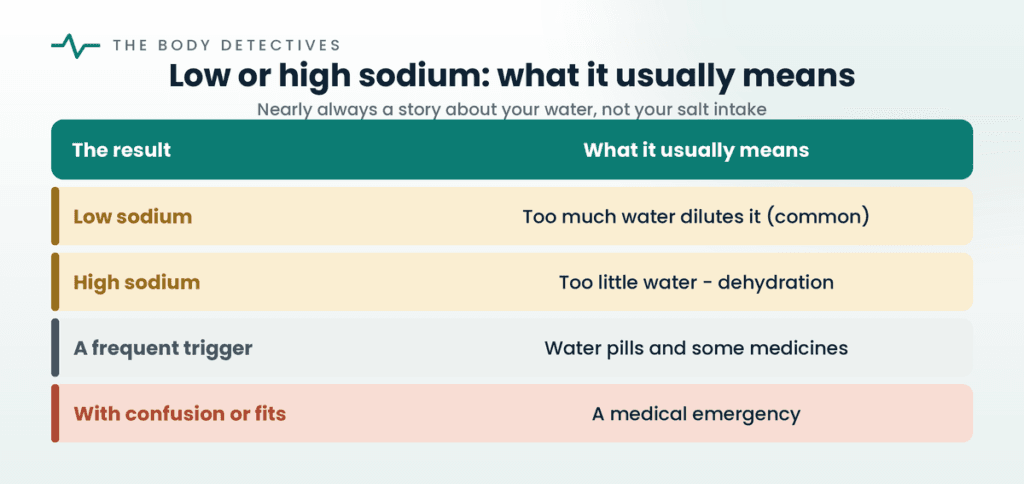
Medicines matter here too — water tablets (diuretics) and some antidepressants are among the most common triggers for a low reading. And because sodium and potassium are the two electrolytes measured side by side on almost every panel, an odd sodium is always read alongside the rest to build the full picture.
When to see a doctor
You will rarely test your own sodium; it turns up as part of a routine or kidney panel. What matters is recognising when an imbalance is doing harm, because the symptoms are mostly neurological: headaches, nausea, confusion, unusual drowsiness, weakness or muscle cramps — and, at the extremes, seizures. These deserve urgent attention, especially if they come on quickly. One note for the very active: drinking enormous amounts of water during long endurance events can dangerously dilute your sodium, so match your fluids to your needs rather than forcing litres down. If a blood test flags your sodium, your doctor will look at your fluid state and medicines first, and correct it gradually — because moving it too fast can be harmful in itself.
The bottom line
Sodium is the headline electrolyte, but the lesson of the test is counterintuitive: it is a window onto your water, not your salt. A low level almost always means too much water diluting the blood; a high level means too little. Cutting or adding salt at the dinner table is rarely the answer — the real story lies in hydration, hormones and the organs that manage your fluid. If your result is off, it is your body’s water balance, far more than your seasoning, that is doing the talking.
This article is for general educational purposes only and is not a substitute for professional medical advice, diagnosis or treatment. If you have confusion, a severe headache, drowsiness, seizures or other worrying symptoms, or questions about your sodium result, seek medical advice promptly. See our Medical Disclaimer for more information.