Bilirubin: The Pigment Behind Jaundice and Yellow Eyes
Bilirubin is the yellow pigment behind one of medicine’s most visible signs: jaundice, the yellowing of the skin and eyes. It is made constantly, as a natural by-product of your body recycling worn-out red blood cells, and in normal amounts it is simply cleared away by your liver. So when bilirubin shows up as high on a blood test, it is telling a story about that whole journey — from your red cells, through your liver, and out in your bile. Here is what bilirubin is, why a high level matters, and when a raised reading is nothing to worry about at all.
What bilirubin is and where it comes from
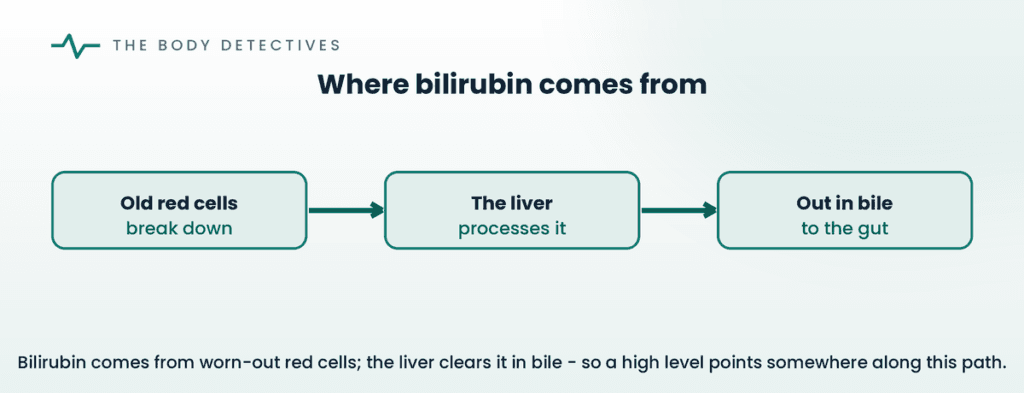
Every day, your body retires millions of old red blood cells, and as they are broken down they release bilirubin, a yellow-orange pigment. Your liver picks it up, processes it into a form that dissolves in water, and sends it out in bile — the fluid that flows into your gut to help digest fats and, along the way, gives stool its brown colour. Laboratories often report it as two numbers: “indirect” bilirubin, the raw form before the liver has worked on it, and “direct” bilirubin, the processed form — and the balance between the two is itself a clue to where any problem lies. In a healthy system this all runs quietly in the background, leaving only a small, steady amount in the blood. The diagram below traces that path.
Why a high bilirubin matters
Because bilirubin passes through several stages, a raised level is really a clue to where something has gone wrong — and doctors find it useful to think in terms of three points along the path. The chart below lays them out.
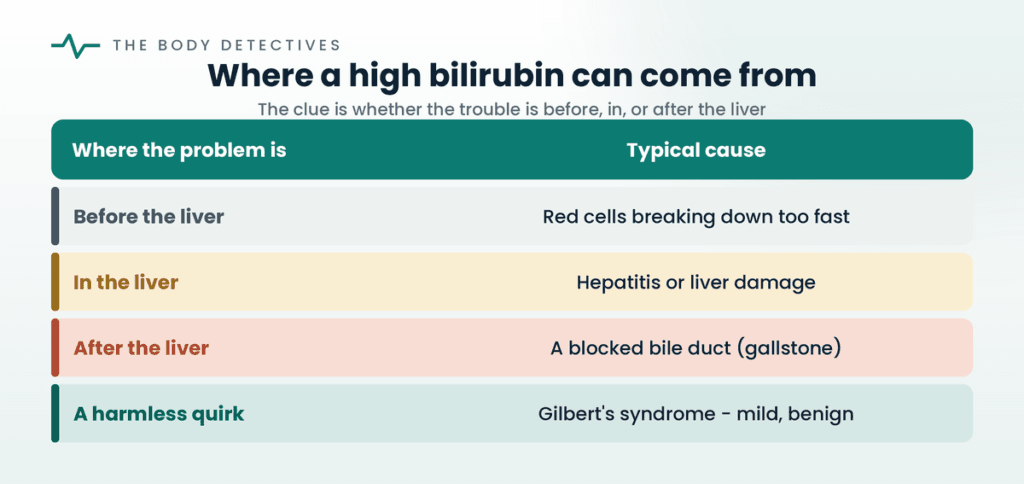
The problem can sit before the liver, where red blood cells are broken down too fast and overwhelm the system; in the liver itself, where damage from hepatitis or other liver disease stops it being processed, often alongside changes in albumin and other liver markers; or after the liver, where a blocked bile duct — a gallstone, say — dams it up. That last group often comes with tell-tale signs: pale stools and dark urine, because the pigment can no longer take its normal route out.
When to see a doctor
Visible jaundice — yellow skin or eyes — always deserves a prompt medical review, and so does jaundice with pale stools, dark urine, severe tummy pain or fever, which can signal a blocked duct or a serious liver problem. In a newborn, jaundice is common and usually harmless, but it should always be checked, as very high levels need treatment. One reassuring note: a mild, isolated rise in bilirubin with everything else normal is often Gilbert’s syndrome — a common, harmless inherited quirk in which bilirubin drifts up when you are fasting, stressed or unwell. It needs no treatment, but only your doctor can confirm that is what it is.
The bottom line
Bilirubin is the pigment your body makes when it recycles red blood cells, and your liver clears it away in bile. A high level is a signpost rather than a diagnosis: it points to where the problem lies — too much breakdown, a struggling liver, or a blocked duct — and the pattern guides what to check next. Visible jaundice should always be seen by a doctor, but it is worth remembering that a small, lone rise is frequently the harmless Gilbert’s kind.
This article is for general educational purposes only and is not a substitute for professional medical advice, diagnosis or treatment. Jaundice in yourself or your baby should always be assessed by a doctor; if you notice yellow skin or eyes, pale stools or dark urine, seek medical advice promptly. See our Medical Disclaimer for more information.