
Free T3: The Active Thyroid Hormone Explained
Free T3 is the thyroid result that appears less often than TSH or T4 — but it measures the hormone that actually does the work. T3, or triiodothyronine, is the active thyroid hormone: the one that reaches your cells and sets the pace of your metabolism. What is surprising is where it comes from. Your thyroid makes only a little T3 directly; most of it is produced by converting T4 — the reserve hormone — into T3 out in your tissues. The word “free” simply means the active, unbound portion the lab can measure. Here is what free T3 is, and when it is actually worth testing.
What free T3 is
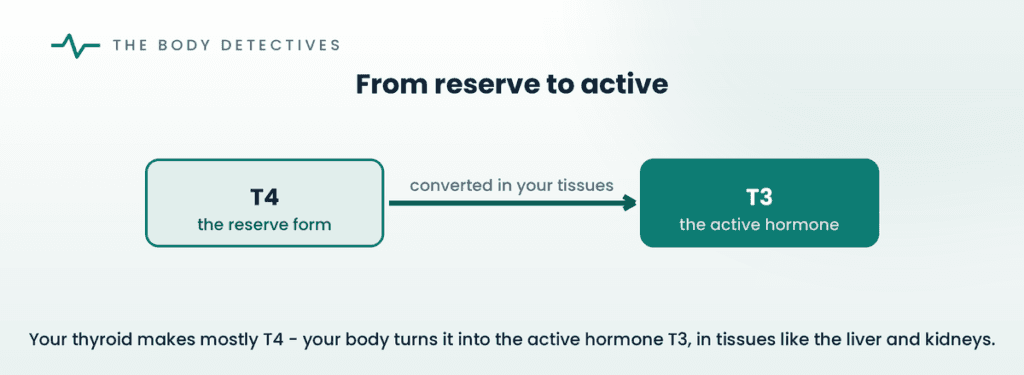
Think of your thyroid hormones as a team with different jobs. TSH is the message from the pituitary; T4, or thyroxine, is the abundant reserve; and T3 is the potent, active form that genuinely drives your cells — regulating your heart rate, temperature, energy and more. Only about a fifth of your T3 comes straight from the thyroid; the other four-fifths is made by converting T4 in tissues such as the liver and kidneys, wherever the body needs it. The diagram below shows that handover.
When free T3 actually helps
Because T4 and T3 usually move together, free T3 is a second-line test rather than a routine one — you will not see it on every thyroid panel. Its real value is in an overactive thyroid: when the gland is running hot, T3 often rises earlier and higher than T4, and occasionally it is the only hormone that is raised, a pattern called “T3 toxicosis” that T4 alone would miss. For an underactive thyroid, by contrast, T3 adds little — TSH and free T4 tell that story better. The chart below shows where free T3 earns its place.
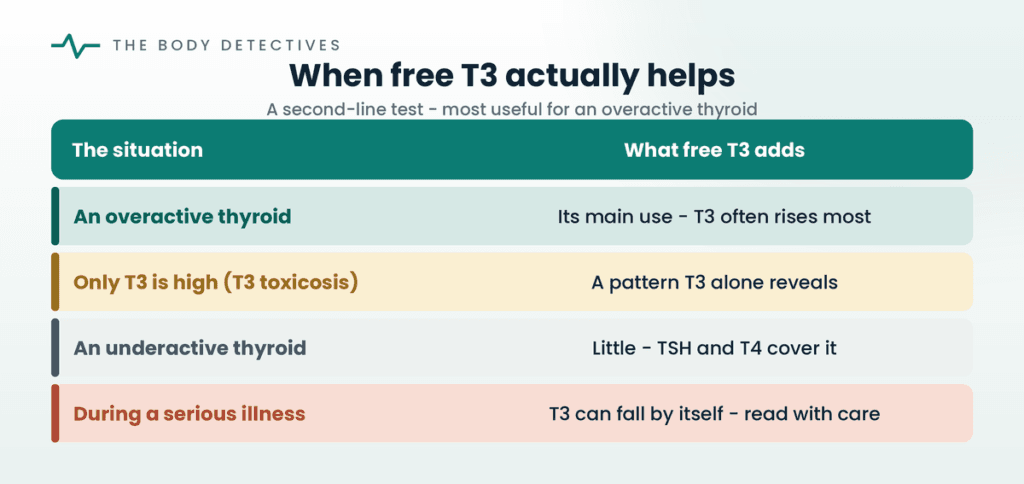
There is one important trap. In people who are seriously unwell for reasons unrelated to the thyroid, the body deliberately converts less T4 into T3 to save energy, so free T3 falls — a state doctors call “low T3 syndrome”. It looks alarming, but the thyroid itself is usually fine, and treating it as thyroid failure would be a mistake. It is another reminder that a single hormone is best read in context, not in isolation.
When to see a doctor
You will not usually request a free T3 yourself; a doctor adds it when the picture points to an overactive thyroid or needs clarifying. The symptoms that prompt it are those of a body running too fast: a racing or irregular heartbeat, weight loss despite a good appetite, feeling hot and sweaty, trembling hands, restlessness or anxiety. If several of these build up — especially with a noticeable change in your pulse — it is worth getting your thyroid checked. And if you already know you have a thyroid condition, let your own doctor decide which of the three tests you actually need, rather than chasing every number.
The bottom line
Free T3 is the active end of the thyroid system — the hormone your cells actually respond to — but it is a specialist’s tool, not a routine box to tick. It comes into its own when an overactive thyroid is suspected, and it can be misleading during serious illness, which is why doctors reach for it selectively. Read as part of the team with TSH and T4 it completes the thyroid picture; read alone, it can easily point the wrong way.
This article is for general educational purposes only and is not a substitute for professional medical advice, diagnosis or treatment. If you have symptoms of an overactive thyroid, such as a racing heartbeat, tremor or unexplained weight loss, or questions about your thyroid results, speak to your own doctor. See our Medical Disclaimer for more information.