Free T4: The Thyroid Hormone Behind Your Metabolism
Free T4 is one of the numbers that appears when a doctor checks your thyroid — and, alongside TSH, it is one of the most useful. T4, or thyroxine, is the main hormone your thyroid gland makes, and it acts like a throttle for the whole body, setting the speed at which everything runs. The word “free” simply means the active portion floating in your blood, ready to work. But here is the key: free T4 is rarely judged on its own. It is read next to TSH, and it is the pattern of the two together that tells the real story. Here is what free T4 does, and what a high or low level means.
Free tool
Have your thyroid results? Decode them in seconds.
Enter your TSH, and your Free T4 and Free T3 if you have them. Our free TSH Interpreter shows where your result sits and what it suggests, and gives you the questions to ask your doctor.
Open the TSH Interpreter →Educational only, not a diagnosis.
What free T4 is and does
Your thyroid, a small butterfly-shaped gland in your neck, mostly makes thyroxine — T4 — which travels round the body and is converted in the tissues into the more active hormone, T3. Together they set your metabolic rate: how fast your cells burn energy. That reach is enormous, touching your heart rate, temperature, weight, digestion and mood. Most of your T4 is bound to proteins and inactive, so the lab measures the small “free” fraction — the part that is actually doing the work.
Why free T4 is read with TSH
The thyroid does not act alone. Your pituitary gland watches the hormone level and sends out TSH — thyroid-stimulating hormone — to tell the thyroid to speed up or slow down. When there is plenty of T4, the pituitary eases off and TSH falls; when T4 runs low, the pituitary pushes harder and TSH rises. The diagram below shows that loop.
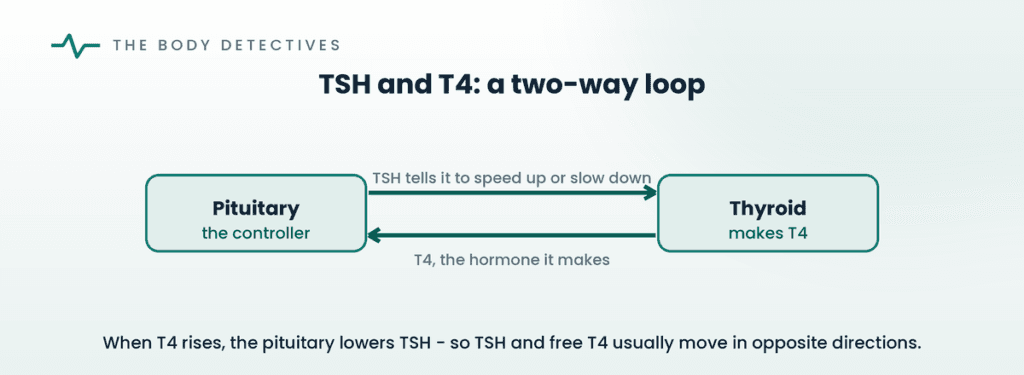
Because of that feedback, TSH and free T4 usually move in opposite directions — and it is the combination that pinpoints the problem. The chart below lays out the main patterns.
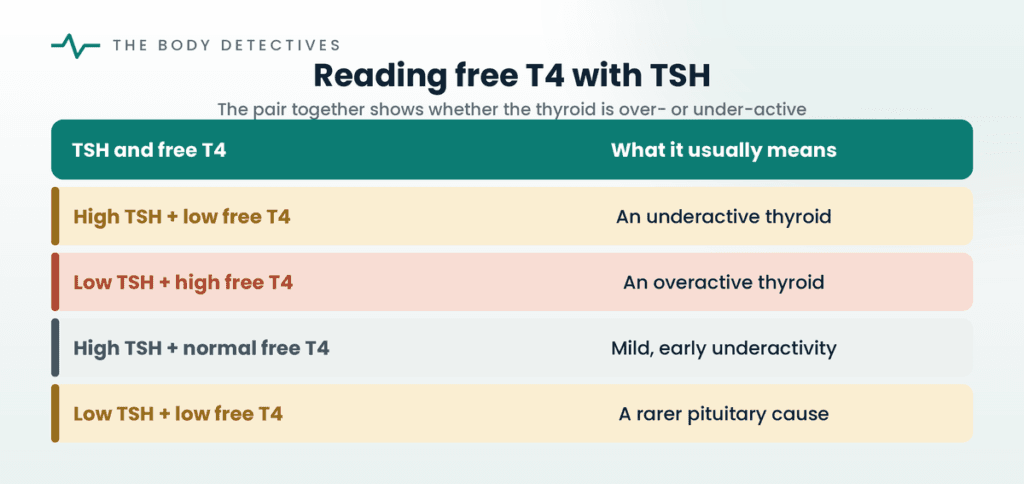
A high TSH with a low free T4 is the classic picture of an underactive thyroid (hypothyroidism), where the gland cannot keep up and the pituitary is straining to push it. The mirror image — a low TSH with a high free T4 — points to an overactive thyroid (hyperthyroidism). And when TSH is raised but free T4 is still normal, it often means an early, mild underactivity worth keeping an eye on. Reading the two together is what turns a set of numbers into an actual answer.
When to see a doctor
Thyroid problems are common and very treatable, so the symptoms are worth knowing. An underactive thyroid tends to slow you down: tiredness, weight gain, feeling the cold, dry skin, constipation and low mood. An overactive one speeds you up: weight loss despite a good appetite, a racing or irregular heartbeat, feeling hot and sweaty, shakiness and anxiety. If a cluster of these creeps up on you, a simple blood test for TSH and free T4 can settle the question — and if your heart is racing or pounding, or you feel severely unwell, do not wait to get it checked.
The bottom line
Free T4 is the working thyroid hormone — the throttle that sets your body’s pace — and TSH is the pituitary’s way of adjusting it. Neither number means very much alone, but read as a pair they reveal whether your thyroid is running fast, slow or just right. If your energy, weight or tolerance of hot and cold has shifted without explanation, this pair of tests is often exactly where the answer lies.
This article is for general educational purposes only and is not a substitute for professional medical advice, diagnosis or treatment. If you have symptoms of an over- or under-active thyroid, or questions about your results, speak to your own doctor, who can interpret your TSH and free T4 together. See our Medical Disclaimer for more information.